|
|
|
Wholesalers: |

|
/ |
|
|
|
|
|
|
|
|
| "Endurance is one of the most difficult disciplines, but it is to the one who endures that the final victory comes." Shakyamuni Buddha (563-483 B.C.) |
|
|
|
|
|
|
|
|
|
|
|
|
|
|
|
|
|
|
|
|
|
|
|
|
Sku#:0582
|
|
|
Wholesale price |
US |
XXX.XX |
|
《In order to view the wholesale price .
Please Apply to be a wholesalers》
|
|
|
|
|
 |
|
Please contact us to verify availability. 1-626-354-6228
Email: zambalallc@gmail.com
America area customers can view on this website first.
https://FlyingMystics.org/ |
|
|
|
|
|
|
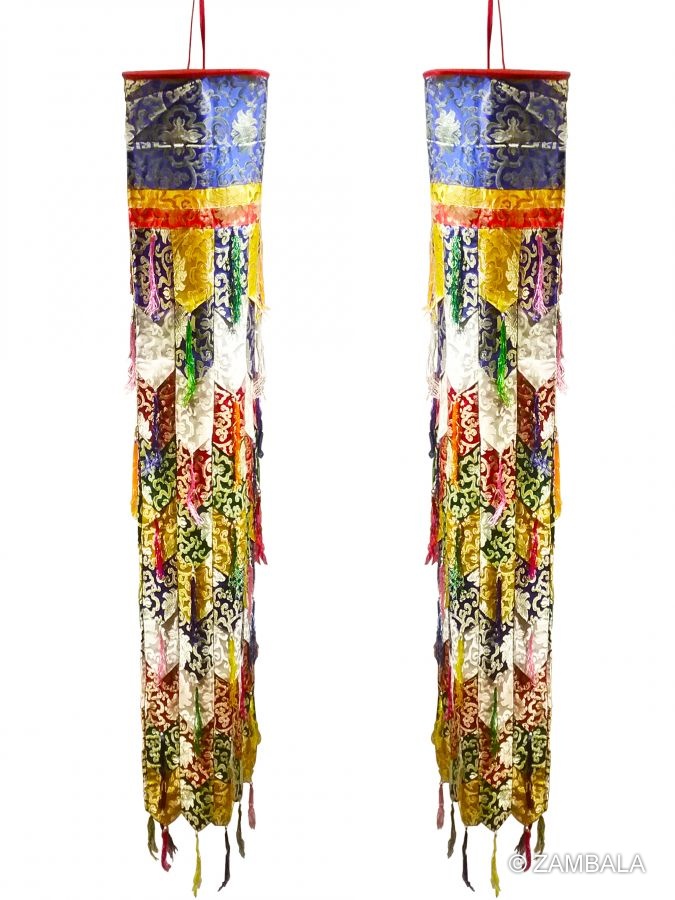
Material: Fabric, Embroidery, Printed
Size: Approximately 5 feet (150 cm) long
Description: The Meaning and Origin of the Dharma Banner
The Dharma banner is an important symbol in Buddhism. Its full name is "Dharmadhvaja," meaning "banner of the Dharma" or "sign of the Dharma." It symbolizes the Buddha's teachings (Dharma) as a towering banner, universally benefiting all sentient beings, dispelling the darkness of ignorance, and proclaiming the victory of the true Dharma.
Origin
1. **Scriptural Basis**
- First appeared in the *Lotus Sutra*, Chapter 1, "Parable": "Like a lamp in the dark, like a banner in the dark, shining brightly and illuminating all." Later, it gradually evolved into a concrete object.
- In Mahayana scriptures such as the *Avatamsaka Sutra* and the *Medicine Buddha Sutra*, the "Dharma banner" is often used as a metaphor for the exaltation and pervasive illumination of the Dharma.
- In the *Mahaprajnaparamita Sutra*, Nagarjuna Bodhisattva also used the term "Dharma Banner" to describe the scene of a Bodhisattva proclaiming the Dharma and subduing heretics.
2. **Historical Development**
- In Indian Buddhism: Initially, it was merely a metaphor and had not yet become a physical object.
- With the introduction of Buddhism to China (especially after the rise of Esoteric Buddhism in the Tang Dynasty), the Dharma Banner was concretized and became one of the important ritual implements in temples and Dharma assemblies.
- In the Esoteric Buddhist scriptures translated by Amoghavajra during the Tang Dynasty (such as the *Vajrasekhara Yoga Sutra*), the methods for making and using "precious banners" and "banners" were clearly described.
- After the Song Dynasty, the Dharma Banner was widely used in the rituals of Han Chinese Buddhism, the Tiantai, Huayan, Chan, and Esoteric schools, becoming one of the "Eight Auspicious Symbols" or "Eight Treasures."
Usage and Forms
There are two main forms of Dharma banners:
1. **Physical Dharma Banner (Erected in temples or at Dharma assemblies)**
- Shape: Usually an octagonal or circular tall wooden (or metal) pillar, ranging in height from 1 meter to over ten meters.
- Structure:
- The top is a jewel (or a seven-jeweled umbrella).
- The middle section has an eight- or multi-faceted "banner body" made of silk or brocade, embroidered or inscribed with mantras, Buddha and Bodhisattva names, the Eight Auspicious Symbols, etc.
- The lower section is adorned with tassels, bells, and necklaces.
- Placement: Commonly erected on either side of the plaza in front of the main hall, in front of the dining hall, in front of the Heavenly Kings Hall, or in the center of large Dharma assemblies.
- Famous Examples: Huge gilded Dharma banners can be found at the Yonghe Temple in Beijing, Wannian Temple on Mount Emei, and Fayu Temple on Mount Putuo.
2. **Handheld or Small Dharma Banners in Ceremonies**
- In esoteric Buddhist rituals such as the Water and Land Dharma Assembly, the Flaming Mouth Ritual, and the Yoga Flaming Mouth Ritual, four "Four-Directional Treasure Banners" are erected at the four corners of the altar.
- Monks carry small Dharma banners while circumambulating the Buddha and the altar, symbolizing the subjugation of the four demons and the universal protection of the four assemblies through the Dharma.
Influence on Buddhist Culture
1. **Deepening of Symbolic Meaning**
- The Dharma banner became a symbol of "the permanence and indestructibility of the Dharma." Whenever a temple is completed, a Buddha statue is consecrated, or a major Dharma assembly is held, the erection of the Dharma banner signifies "the continued existence of the true Dharma."
- In an era where the idea of the Dharma-ending Age is prevalent, the Dharma banner is further regarded as a concrete symbol of "protecting the true Dharma."
2. **Influence on Architecture and Art**
- Many large temples have a pair of "banners" (壽騰) facing "ornamental columns" (華表) in front of their gates, becoming a classic layout in Chinese Buddhist architecture (such as Xiantong Temple on Mount Wutai and Lingyin Temple in Hangzhou). - The octagonal design of the Dharma banner influenced the shapes of later sutra banners and stone pillars (such as the Dharani sutra banners popular during the Tang and Song dynasties).
3. **Standardization of Ritual and Dharma Assembly**
- The "four inner altar banners" in water and land paintings became a standard configuration.
- In the ritual of releasing hungry ghosts, "erecting the banner" is an important procedure, representing the invitation of wandering souls to the Dharma seat to listen to the sutras and receive food.
4. **Integration into Folk Beliefs**
- In Chinese folk tradition, the Dharma banner is often used interchangeably with "wind flags" and "soul-summoning banners." In some places, "soul-guiding banners" are also erected at funerals. Although this differs from orthodox Buddhist doctrine, it demonstrates the extent to which the Dharma banner design has penetrated the folk tradition.
In summary, the Dharma banner, initially a metaphor in scriptures, has evolved into one of the most representative ritual implements in Han Chinese Buddhism. It is not only a beautiful work of art but also a concrete symbol of the core spirit of "the exaltation of Buddhism and the universal benefit of all sentient beings." Even today, various forms of Dharma banners can still be seen in Han Chinese Buddhist temples in China, Japan, Korea, and Vietnam, silently telling the story of the transmission and flourishing of Buddhism in East Asia for over a thousand years.
.jpg)
|
|
|
 |
|
|
|
|
|
|
|
|
|
|
|
|
|
|
|
|
© 2026 Zambala inc. All Rights Reserved. No part of this site may be reproduced without our written Permission.
Service Mail: ZambalaLLC@gmail.com
Phone: (626) 289-9787 or 1(888)Zambala (926-2252)
Fax: (626) 289-9719
1904 West Valley Blvd. Alahambra, CA 91803 USA
Unless stated otherwise in content's license. Design By
|
|
|