|
|
|
Wholesalers: |

|
/ |
|
|
|
|
|
|
|
|
| “Many people think excitement is happiness.... But when you are excited you are not peaceful. True happiness is based on peace.”
― Thich Nhat Hanh, The Art of Power |
|
|
|
|
|
|
|
|
|
|
|
|
|
|
|
|
|
|
|
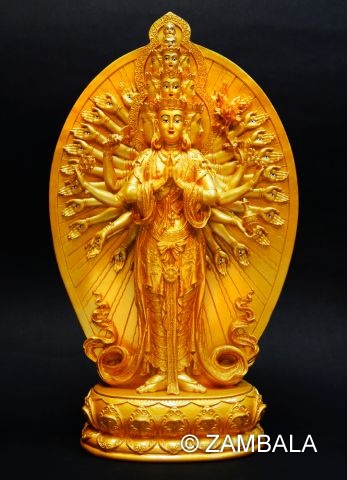
| 11 face Avalokistevara 12" |
|
|
|
Attribute : polyresin
Size : 12"
|
|
Sku#:0238
|
|
《In order to view the wholesale price .
Please Apply to be a wholesalers》
|
|
|
|
|
 |
|
Please contact us to verify availability. 1-626-354-6228
Email: zambalallc@gmail.com
America area customers can view on this website first.
https://FlyingMystics.org/ |
|
|
|
|
|
|
Material: Plastic, Painted, Molded
Size: 12 inches, approximately 32 cm
Description: Thousand-Armed Guanyin, also known as the Thousand-Armed and Thousand-Eyed Guanyin Bodhisattva, is a special manifestation of Guanyin Bodhisattva (Avalokiteśvara) in Buddhism. She primarily symbolizes boundless compassion and the ability to save sentient beings, extending a thousand hands simultaneously to help countless beings. Each hand often has an eye, representing wisdom and insight. Guanyin Bodhisattva is generally regarded as the embodiment of compassion in Buddhism and is widely worshipped in Mahayana Buddhism, especially in China, Japan, and Southeast Asia. Although the user mentions "his," in Han Chinese Buddhism, Guanyin is often depicted as female or androgynous.
Mythological Story and Origin
The origin of the Thousand-Armed Guanyin mainly comes from Buddhist scriptures, such as the *Great Compassion Dharani Sutra of the Thousand-Armed and Thousand-Eyed Guanyin Bodhisattva* (abbreviated as the *Thousand-Armed Sutra*). According to classical texts, countless eons ago, Avalokiteshvara Bodhisattva was already a bodhisattva who vowed to liberate all sentient beings from suffering. In the process of saving sentient beings, after countless eons, he discovered that beings in the six realms of reincarnation still suffered greatly, experiencing countless births and deaths. Therefore, he made a great vow: if he could not save all sentient beings, he vowed that his body would shatter into dust. However, due to the immense suffering of sentient beings, his head, out of grief, split into eleven pieces, and his body shattered into a thousand pieces. At this time, Amitabha Buddha (or Shakyamuni Buddha in some versions) helped him with his supernatural powers, restoring his split head to eleven faces (symbolizing the observation of the ten directions), and his body to the form of a thousand hands and a thousand eyes, each hand bearing an eye, representing the ability to simultaneously save sentient beings with unobstructed compassion and wisdom.
Furthermore, in Chinese folklore, there is a more dramatic version: King Miaozhuang had three daughters. His third daughter, Princess Miaoshan (an incarnation of Avalokiteshvara), became a nun. After her father fell ill, she offered her hands and eyes to heal him. Moved by her plight, King Miaozhuang intended to bestow upon her the title of "Bodhisattva with All Hands and Eyes," but mistakenly said "Thousand Hands and Thousand Eyes." Because the emperor's word was law, Miaoshan manifested as the Thousand-Handed and Thousand-Eyed Guanyin. This legend is common in folk novels and operas, such as "Guanyin Attains Enlightenment," and has influenced the sculptures and artistic expressions in many temples.
The origins of these stories can be traced back to the Guanyin faith in Indian Buddhism. After being introduced to China, it merged with local culture, forming the unique image of the Thousand-Handed Guanyin. The earliest records date back to the Tang Dynasty, related to Esoteric Buddhism, emphasizing the practice through Dharanis (mantras) such as the Great Compassion Mantra.
Influence on Buddhism
The Thousand-Handed Guanyin has had a profound influence on Buddhism, mainly reflected in the following aspects:
1. **Strengthening the Concept of Compassion:** As a core Bodhisattva of Mahayana Buddhism, the Thousand-Handed Guanyin symbolizes "universal manifestation," meaning she can appear in various forms to save sentient beings. This reinforced the Buddhist concept of compassion (karuṇā), encouraging believers to cultivate Bodhicitta and influencing the practices of the Huayan, Pure Land, and Tantric schools. For example, in Pure Land Buddhism, Avalokiteshvara is often depicted alongside Amitabha Buddha as an attendant bodhisattva in the Western Pure Land.
2. **Art and Cultural Dissemination:** The image of the Thousand-Armed Avalokiteshvara appears extensively in Buddhist art, such as the murals in the Mogao Caves of Dunhuang, temple sculptures, and dances (e.g., the Thousand-Armed Avalokiteshvara dance in China). This not only enriched Buddhist art but also promoted the popularization of Buddhism in Asia, transforming it from an elite religion into a mass faith. In China, Avalokiteshvara worship even merged with Taoism and folk religions, forming a unique Avalokiteshvara culture.
3. **Practice and Ritual:** The Thousand-Armed Avalokiteshvara is closely associated with the Great Compassion Mantra, with believers seeking protection through reciting the mantra. This is particularly important in Tantric Buddhism, influencing Avalokiteshvara practices in Tibetan Buddhism (such as the Six-Syllable Mantra). In modern Buddhism, the Thousand-Armed Avalokiteshvara is still regarded as a protector in times of disaster, promoting Buddhist social charitable activities such as disaster relief and medical assistance.
Overall, the Thousand-Armed Avalokiteshvara has not only deepened the Buddhist spirit of compassion but has also become an important symbol of Asian Buddhist culture, its influence remaining strong to this day.
|
|
|
 |
|
|
|
|
|
|
|
|
|
|
|
|
|
|
|
|
© 2026 Zambala inc. All Rights Reserved. No part of this site may be reproduced without our written Permission.
Service Mail: ZambalaLLC@gmail.com
Phone: (626) 289-9787 or 1(888)Zambala (926-2252)
Fax: (626) 289-9719
1904 West Valley Blvd. Alahambra, CA 91803 USA
Unless stated otherwise in content's license. Design By
|
|
|