|
|
|
Wholesalers: |

|
/ |
|
|
|
|
|
|
|
|
| "After happiness comes suffering. After suffering arises happiness. For beings happiness and suffering Revolve like a wheel." Nagarjuna |
|
|
|
|
|
|
|
|
|
|
|
|
|
|
|
|
|
|
|
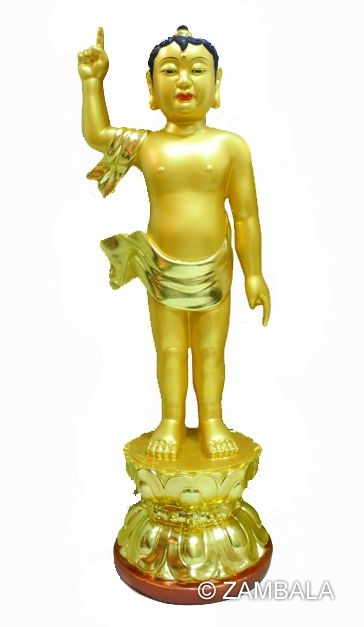
| Baby Buddha, Standing 16〝H |
|
|
|
|
|
Sku#:2674
|
|
《In order to view the wholesale price .
Please Apply to be a wholesalers》
|
|
|
|
|
 |
|
Please contact us to verify availability. 1-626-354-6228
Email: zambalallc@gmail.com
America area customers can view on this website first.
https://FlyingMystics.org/ |
|
|
|
|
|
|
Material: Plastic, Painted, Molded
Size: Approximately 16 inches / 45cm
Description: Prince Siddhartha, also known as Siddhartha Gautama, was the secular name of Shakyamuni Buddha, the founder of Buddhism. He was born in Lumbini (present-day Nepal) between approximately 623 and 563 BCE, into the Shakya clan, a prince of the Kshatriya caste. His father was King Suddhodana, and his mother was Queen Maya. The life story of Prince Siddhartha blends historical and mythological elements, becoming a core narrative in Buddhist scriptures. It originates from early Buddhist canons such as the Agamas and Vinaya Pitaka, and was later expanded and mythologized by Mahayana Buddhist texts such as Asvaghosa's *Buddha's Deeds*.
Origin of the Mythological Story: The mythological story of Prince Siddhartha primarily originates from Buddhist scriptures and biographies, emphasizing his extraordinary birth, his path to enlightenment, and his reflections on human suffering. These stories are not only historical records but also incorporate mythological elements to symbolize the wisdom and liberation of Buddhist teachings.
- **Birth Myth:** Legend has it that Queen Maya dreamt of a six-tusked white elephant descending from the sky and entering her right side, symbolizing the birth of the prince. After ten months of pregnancy, the prince was born from his mother's right side in Lumbini Garden. Upon birth, he could walk seven steps, each step producing a lotus flower, and pointed to the sky, declaring, "In heaven and on earth, I alone am the honored one." At this moment, a rain of flowers fell from the sky, and nine dragons spouted water to bathe him. The sage Asita observed the prince with his divine eye and prophesied that if he remained at home, he would become a universal monarch; if he renounced the world, he would become a fully enlightened Buddha. This myth originates from Buddhist scriptures and emphasizes that the prince possessed the thirty-two major marks of a great man (such as the thousand-spoked wheel under his feet and the mark of the hidden horse) and the eighty minor marks of a great man, symbolizing his extraordinary destiny.
- **Early Life and Renunciation:** The prince lived a luxurious life in the palace, raised by his aunt Mahapajapati Gotami, and learned both literary and martial arts. After reaching adulthood, he married Yashodhara and had a son, Rahula. However, he questioned the suffering of humanity: during a journey, he encountered an old man, a sick person, a dead person, and a practitioner (known as the "Four Gates of Contemplation"), gaining a profound understanding of the suffering of birth, old age, sickness, and death. At the age of 29, he rode out of the city at midnight, leaving the palace to become a monk. This story, originating from classical records, symbolizes the prince's renunciation of worldly glory in pursuit of liberation.
- **Asceticism and Enlightenment:** After becoming a monk, the prince first studied meditation under Alara Garan and Uddara Masipharma, but was dissatisfied with their teachings. He then practiced asceticism for six years with five monks in a grove, enduring extreme abstinence to the point of fainting. Later, a shepherdess offered him milk, leading him to realize the "Middle Way" (neither extreme bliss nor extreme suffering). At the age of 35, he meditated for seven days under the Bodhi tree in Bodh Gaya, subduing the temptations of Mara, attaining the Four Dhyanas, the Three Knowledges (knowledge of past lives, divine eye, and the extinction of defilements), and fully comprehending the Four Noble Truths (suffering, the origin of suffering, the cessation of suffering, and the path to the cessation of suffering) and the Twelve Links of Dependent Origination, thus becoming the Buddha (the Awakened One). This enlightenment myth emphasizes inner awakening, originating from early Buddhist scriptures, and was mythologized in Mahayana Buddhism as a process imbued with supernatural powers.
- **Preaching and Nirvana:** After enlightenment, the Buddha gave his first sermon in Sarnath, expounding the Four Noble Truths and the Eightfold Path to the five ascetics, thus establishing the Sangha. He traveled throughout India for 45 years, extensively guiding sentient beings, including his ten great disciples such as Sariputra and Maudgalyayana. At the age of 80, he entered Nirvana under the twin Sala trees in Kushinagar. After being poisoned by eating sandalwood, he lay on his right side with his head to the north, leaving instructions for his disciples to uphold the precepts and practice discipline. After Nirvana, his body was cremated, and his relics were distributed to eight kings to build stupas for their worship. This story originates from the Vinaya Pitaka and symbolizes the end of the cycle of rebirth.
These mythological stories primarily originate from the Buddhist Tripitaka (Sutras, Vinaya, and Abhidharma), initially transmitted orally, and later fixed in compilations after the Buddha's passing (such as the First Buddhist Council in Rajagaha). Mythological elements are influenced by Indian tradition; for example, the white elephant originates from Indian mythology, aiming to highlight the Buddha's extraordinary nature and his mission to liberate all sentient beings.
Influence on Buddhism: Prince Siddhartha, as Shakyamuni Buddha, is the founder of Buddhism. His enlightenment and teachings directly shaped the core system of Buddhism, profoundly influencing religions worldwide.
- **Establishing Buddhist Doctrines:** The Buddha's teachings are preserved in scriptures such as the Agamas, including the Four Noble Truths (recognizing suffering, eliminating the causes of suffering, realizing the cessation of suffering, and cultivating the path), the Eightfold Path (right view, right thought, etc.), the Twelve Links of Dependent Origination (the law of dependent origination, explaining rebirth and liberation), and the Thirty-Seven Factors of Enlightenment. He emphasized the Middle Way, non-self, karma, and Nirvana, rejected Brahmanical sacrifices, and advocated that everyone can attain Buddhahood. This atheistic system influenced Buddhism to become a religion emphasizing introspection and ethics.
- **Founding and Spread of the Sangha:** Beginning with the five ascetics, the Sangha expanded to 1250 members, establishing precepts and forming the Three Jewels (Buddha, Dharma, Sangha). After the Buddha's passing, the teachings spread throughout India, reaching Sri Lanka and Southeast Asia during the reign of Ashoka, splitting into Theravada (Southern Buddhism) and Mahayana Buddhism (Northern Buddhism). Chinese Buddhism was influenced by this, spreading widely during the Wei, Jin, and Northern and Southern Dynasties, merging with folk religions, and deifying the Buddha as a protector deity. The eastward transmission of Buddhism influenced East Asian culture, such as the temple architecture and Zen Buddhism in Japan and Korea.
- **Global Influence:** Buddhism became one of the world's three major religions. Although it declined in its homeland of India after the 12th century, it has spread to Europe and America in modern times, influencing philosophy and psychology (such as mindfulness meditation). The Buddha's egalitarian view (no caste distinctions) promoted social reform, and his myths inspired art and literature, such as the Dunhuang murals and Jataka tales.
In short, the story of Prince Siddhartha is not only a symbol of the origin of Buddhism, but also continues to influence the faith and practice of hundreds of millions of believers.
|
|
|
 |
|
|
|
|
|
|
|
|
|
|
|
|
|
|
|
|
© 2026 Zambala inc. All Rights Reserved. No part of this site may be reproduced without our written Permission.
Service Mail: ZambalaLLC@gmail.com
Phone: (626) 289-9787 or 1(888)Zambala (926-2252)
Fax: (626) 289-9719
1904 West Valley Blvd. Alahambra, CA 91803 USA
Unless stated otherwise in content's license. Design By
|
|
|