|
|
|
Wholesalers: |

|
/ |
|
|
|
|
|
|
|
|
| "The evils of the body are, murder, theft, and adultery; of the tongue, lying, slander, abuse, and idle talk; of the mind, covetousness, hatred, and error." Shakyamuni Buddha (563-483 B.C.) |
|
|
|
|
|
|
|
|
|
|
|
|
|
|
|
|
|
|
|
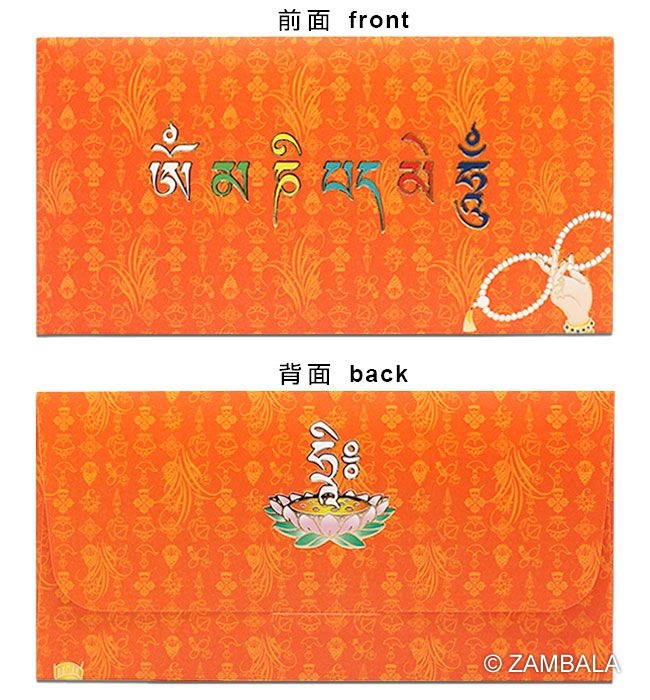
| Mani money envelopes_orangehorizon |
|
|
|
|
|
Sku#:2049_orangehorizon
|
|
《In order to view the wholesale price .
Please Apply to be a wholesalers》
|
|
|
|
|
 |
|
Please contact us to verify availability. 1-626-354-6228
Email: zambalallc@gmail.com
America area customers can view on this website first.
https://FlyingMystics.org/ |
|
|
|
|
|
|
Material: Paper, Hot Stamping, Printing (Red, Orange)
Size: Vertical/Horizontal 18 x 9 cm
Description: The Role of Red Envelopes in Modern Society
Red envelopes (also known as **lucky money**, **lai see**, **red packets**) are one of the most representative traditional customs in Chinese culture, originating in ancient China. Initially, money or items were wrapped in red paper, symbolizing **warding off evil and disaster** and **praying for good fortune** ("red" represents joy and yang energy, and "ya sui" sounds similar to "ya sui," meaning to suppress evil spirits). Today, in modern society, red envelopes have evolved from a simple festive custom into a multifunctional cultural and social tool, playing the following main roles:
1. **A Symbol of Emotional Connection and Blessings**
- **Family Affection**: Elders give red envelopes to younger generations (especially lucky money during Chinese New Year) to convey care, blessings, and protection, strengthening intergenerational bonds. When younger generations reciprocate with red envelopes of gratitude, a "cycle of love" is formed, allowing kinship to continue through material gifts.
- **Interpersonal Relationships:** Red envelopes represent congratulations and courtesy on celebratory occasions such as weddings, full moon celebrations, birthdays, and housewarmings. Modern young people often say, "A red envelope isn't about money, it's about the sentiment," emphasizing that the sentiment is more important than the monetary amount.
2. **A Medium for Social Interaction and Gift-Giving:**
- In the workplace, among friends, and among relatives, red envelopes are "social gifts" for maintaining relationships. The amount often reflects the depth of the relationship, embodying the traditional value of "reciprocity."
- With the emergence of digital formats like WeChat red envelopes, red envelopes have become **entertainment and interaction** tools (such as red envelope games), integrating traditional customs into modern social media and becoming a way for young people to express friendship and team cohesion.
3. **Business and Marketing Tool:**
- Businesses and brands are launching a large number of **customized red envelopes** and **electronic red envelopes** for promotions, employee benefits, and customer rewards. For example, banks and e-commerce platforms distribute red envelopes during the Lunar New Year, making it a powerful marketing tool.
- Red envelopes also reflect socioeconomic changes: the phenomenon of comparing amounts ("lucky money exceeding monthly salary") brings pressure, leading young people to turn to **creative and cultural gifts**, **small red envelopes**, or **non-cash blessings**, attempting to return the custom to its original meaning.
4. **Social Pressure and Reflection**
- In modern society, red envelopes are often commercialized and become a source of competition, leading to "red envelope pressure": giving too much is a burden, giving too little is impolite. Some people therefore advocate "doing what one can afford" or replacing large red envelopes with small gifts.
The Influence of Red Envelopes on Buddhism
Red envelopes are not a core doctrine in Buddhism, but they are deeply influenced by **Chinese Buddhist culture** (especially Han Buddhism) and closely linked to the concept of **giving**. Buddhism considers giving the first of the **Six Perfections** (generosity, morality, patience, diligence, meditation, and wisdom), with the aim of **accumulating merit**, **eliminating greed**, and **benefiting all sentient beings**. The effects of red envelopes in Buddhist practice include:
1. **Positive Impact: Integrating into the Tradition of Giving and Offerings**
- **Offering to the Three Jewels (Buddha, Dharma, Sangha):** When believers visit temples, participate in Dharma assemblies, or pay respects to their teachers, they often offer red envelopes to the Sangha (for adding oil to incense, offering to monks, or giving red envelopes to Rinpoches or Dharma masters). This is considered **material giving**, and the merit can be dedicated to all sentient beings, helping practitioners accumulate blessings and eliminate negative karma.
- **The Concept of Cause and Effect:** Buddhism emphasizes that "the merit of giver and receiver is equal." Giving red envelopes is a good cause that brings blessings; the monks who receive the red envelopes should also use them properly (such as for Dharma propagation or public welfare), avoiding private use. Master Hsing Yun once said, "Material giving and Dharma giving are equal and without difference." If red envelopes are given with a joyful heart, both the giver and the receiver gain merit.
- **Modern Examples:** Many temples centrally allocate red envelopes to **resident temples** (such as for lamp-lighting ceremonies), avoiding personal use and embodying the spirit of equality of "coming from all directions and going to all directions."
2. **Negative Impacts and Warnings**
- **Commercialization and Competitive Giving**: If red envelopes become a means of "buying blessings" or a way to compete in offerings, they easily breed **greed** and **attachment**, violating the Buddhist principle of "formless giving" (non-attachment to giving and receiving). Some critics point out that some temples or individuals over-rely on red envelopes, leading to "hedonistic practice" and affecting the purity of one's spiritual path.
- **Improper Offerings**: If the source of the red envelope is impure (such as embezzlement), the temple should refuse it to avoid polluting the field of merit. Buddhism emphasizes that "a pure mind leads to a pure field of merit," the amount is not important, the key is **joyful heart** and **desirelessness**.
3. **Differences between Tibetan Buddhism and Han Buddhism**
- **Han Buddhism**: Red envelopes are more common and often integrated into daily offerings (such as red envelopes at Dharma assemblies, adding oil to incense). Venerable masters such as Master Hsing Yun and Master Yin Guang affirmed the merits of proper offerings.
- **Tibetan Buddhism:** Offerings to gurus and Rinpoches are also made using red envelopes (**khatas** + red envelopes), considered **offering to a field of merit**, but emphasis is placed on a **pure mind** and **reliance on the Dharma** to avoid falling into the misconception of "buying the Dharma." Some high-ranking monks remind us that offerings should benefit all beings, not just for personal enjoyment.
Conclusion
In modern society, red envelopes have evolved from a simple **festival symbol** into a multifaceted medium for **emotional, social, and commercial purposes**, reflecting the adaptability and change of Chinese culture. For Buddhism, red envelopes are a common form of **giving**, helping people accumulate merit and cultivate compassion, but the key lies in **mindset**: acting with **non-attachment**, **joy**, and **altruism** is the only way to truly gain immeasurable merit. If one falls into comparison or greed, it becomes an obstacle.
|
|
|
 |
|
|
|
|
|
|
|
|
|
|
|
|
|
|
|
|
© 2026 Zambala inc. All Rights Reserved. No part of this site may be reproduced without our written Permission.
Service Mail: ZambalaLLC@gmail.com
Phone: (626) 289-9787 or 1(888)Zambala (926-2252)
Fax: (626) 289-9719
1904 West Valley Blvd. Alahambra, CA 91803 USA
Unless stated otherwise in content's license. Design By
|
|
|