|
|
|
Wholesalers: |

|
/ |
|
|
|
|
|
|
|
|
| "If you want to live a happy life, tie it to a goal, not to people or things." Albert Einstein ( Nobel Prize for Physics in 1921. 1879-1955) |
|
|
|
|
|
|
|
|
|
|
|
|
|
|
|
|
|
|
|
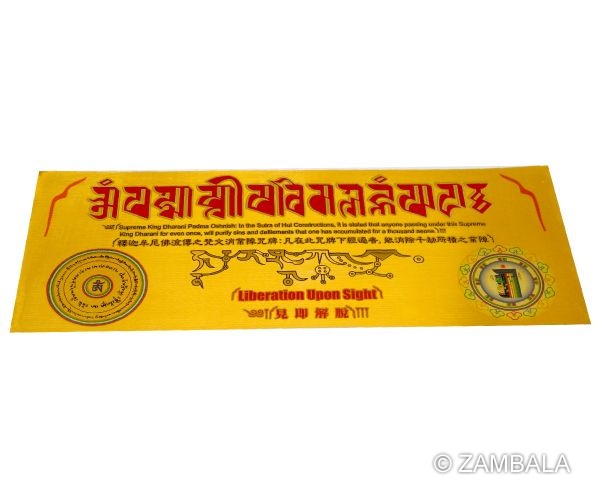
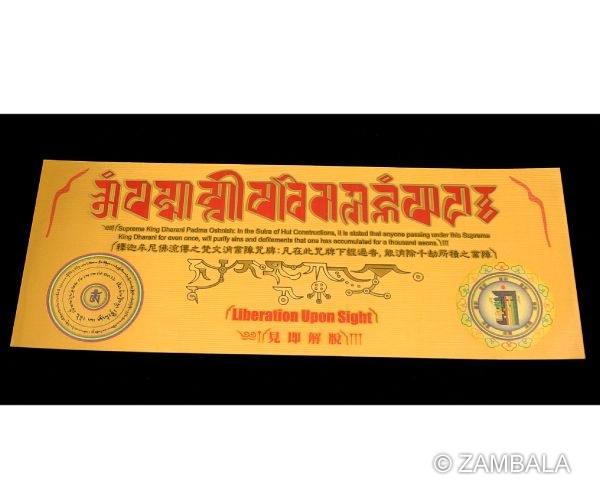
| Liberation upon sight sticker |
|
|
|
|
|
Sku#:2959
|
|
《In order to view the wholesale price .
Please Apply to be a wholesalers》
|
|
|
|
|
 |
|
Please contact us to verify availability. 1-626-354-6228
Email: zambalallc@gmail.com
America area customers can view on this website first.
https://FlyingMystics.org/ |
|
|
|
|
|
|
Material: Hot-stamped, coated, self-adhesive sticker
Size: 11 x 29 CM
Description: Liberation Upon Seeing:
1. The five poisons will be purified.
2. One will not fall into the three lower realms.
3. One will be liberated from the evil realms.
4. One will be liberated from the consequences of one's karma.
5. One will be liberated from the fear of samsara.
Whoever sees, hears, worships, makes offerings, wears, or upholds this mantra,
will have their sins and obstacles eliminated, and will be reborn in the Pure Land after death.
If gods and spirits see or hear this mantra, they will immediately have their sins and obstacles purified, will be quickly reborn in the Pure Land, and will even be absorbed into the ocean of Vairocana's nature.
The Origin of the Tibetan Buddhist "Gateway Mantra"
The Tibetan Buddhist "Gateway Mantra" (also known as the "Wish-Fulfilling Wheel Mantra," "Liberation Gate Mantra," or "Liberation Upon Passing") is a special mantra originating from Tantric scriptures, primarily from Sanskrit sutras and tantras, such as the *Amoghapasa Avalokiteshvara Tantra* (Amoghapasa Mantra Heart Sutra) and related rituals for building houses and protecting the home. It is related to the Kalachakra Tantra and is often considered part of the seal or mantra wheel of the Padmasambhava lineage, incorporating the "Tenfold Mantra of Liberation" (Kalachakra Mantra Wheel).
The origin of this mantra can be traced back to late Indian Tantric Buddhism. After its introduction to Tibet, it was integrated into the Highest Yoga Tantra of Tibetan Buddhism, emphasizing the purification of karmic obstacles and the warding off of evil spirits through the power of mantra blessings. In Tibetan tradition, such mantras are often used to protect the home, purify the deceased (written on paper and placed on the deceased to prevent rebirth in lower realms), or as a daily blessing tool. It is not the heart mantra of a mainstream deity (such as the Six-Syllable Mantra), but rather a practical homa (ritual offering) or home-protecting mantra, similar to the application of feng shui talismans in Central China.
Usage
The most distinctive feature of the "Passing-Through Mantra" is "liberation upon passing"—anyone who **passes beneath the mantra even once** receives blessings:
- **Main Uses**: Make the mantra (often written in Sanskrit or Tibetan, accompanied by the Ten Symbols of Freedom, the Eight Auspicious Symbols, or the Six-Syllable Mantra) into stickers, plaques, thangkas, or signs, and hang them high above the **threshold**, on the door frame, or in places frequently visited by pedestrians (such as the front door of a house, company entrance, temple entrance, overpass beams, etc.).
- **Blessing Effects**: Not limited to humans, any sentient being (including animals and unseen spirits) who passes by, sees, touches, or even merely thinks of this mantra can purify their three karmas (body, speech, and mind), eradicating countless eons of grave sins, even the five heinous crimes. Simply gazing at or remembering it once receives immeasurable blessings.
- **Other Applications:**
- **Protecting the Home and Warding Off Evil Spirits:** Resolves "door sha" (magnetic field conflict caused by two doors facing each other), improving family discord, career setbacks, and health problems.
- **Liberating the Deceased:** Placed on the deceased or inside the coffin to help purify their karmic obstacles.
- **Modern Variations:** Some versions combine wealth-attracting mantras or obstacle-removing mantras for attracting wealth and removing obstacles.
- ****Precautions:** While no specific initiation is required for use, Tibetan Buddhism emphasizes maximizing merit by following the guidance of a guru and dedicating merit with compassion to all sentient beings.
**Profound Influence on Tibetan Buddhism:**
Although the door-crossing mantra is not a core doctrine of Tibetan Buddhism (such as the Six-Syllable Mantra or deity initiation), it has a profound influence on practical application in daily life:
- **Practicality and Popularization:** It embodies the Tibetan Buddhist Tantric spirit of "attaining Buddhahood in this very life" and "living yoga," applying profound mantras to daily life for protection, warding off evil, and eliminating disasters. It integrates elements of Tibetan Bon religion and Indian Tantric Buddhism, making Buddhism more accessible to ordinary people. Tibetans often paint similar mantra wheels on their doors and walls, making them a cultural symbol.
- **Cultivating Good Karma and Universal Salvation:** Emphasizing "indiscriminate blessing" (benefiting all sentient beings, not just humans), it strengthens the compassionate and universal salvation of the Mahayana Bodhisattva path, helping believers accumulate merit and purify karmic obstacles in daily life.
- **Cultural Heritage:** In Tibetan areas and within the Tibetan Buddhist sphere in Han China, these mantras have promoted the integration of Buddhism with Feng Shui and folk customs, expanding its influence. However, they also reflect the "expedient means" characteristic of Tantric Buddhism—while not the ultimate path to liberation, they serve as a bridge guiding sentient beings, indirectly supporting orthodox practices (such as Vidyadhara and initiation).
- **Modern Continuation:** Widely used in monasteries and homes today, they symbolize the inclusiveness and practical orientation of Tibetan Buddhism, helping believers find peace in worldly affairs and ultimately move towards liberation.
In short, the door-entry mantra is a typical practical tool of Tibetan Buddhist Tantric Buddhism, emphasizing the immediacy and universality of the mantra's blessing, and has a lasting impact on folk beliefs and culture. If you wish to deepen your practice, it is recommended to seek guidance from a qualified master to avoid becoming merely a formality.
|
|
|
 |
|
|
|
|
|
|
|
|
|
|
|
|
|
|
|
|
© 2026 Zambala inc. All Rights Reserved. No part of this site may be reproduced without our written Permission.
Service Mail: ZambalaLLC@gmail.com
Phone: (626) 289-9787 or 1(888)Zambala (926-2252)
Fax: (626) 289-9719
1904 West Valley Blvd. Alahambra, CA 91803 USA
Unless stated otherwise in content's license. Design By
|
|
|