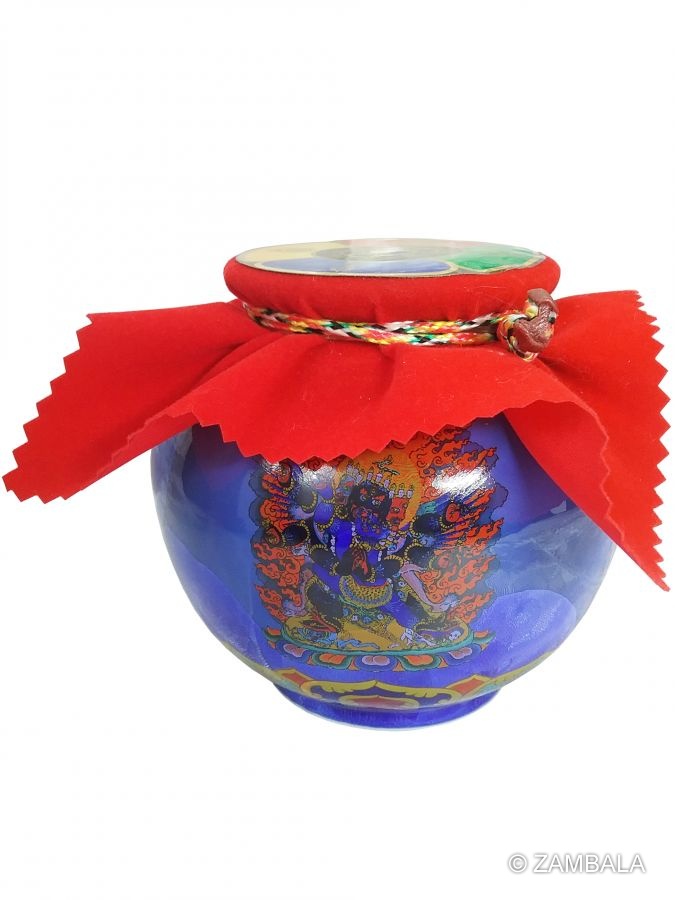
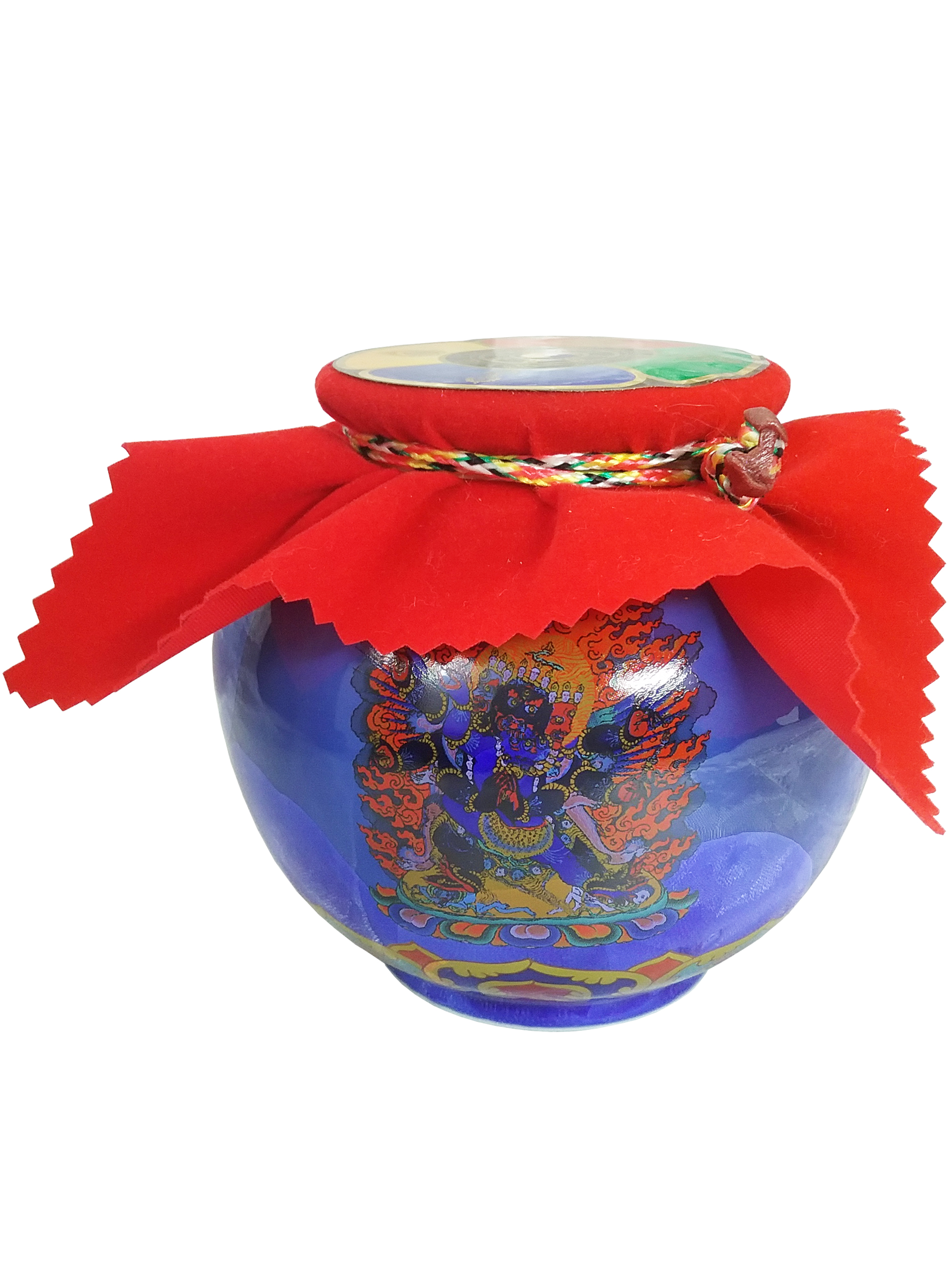
Material: Ceramic (Completed by a professional lama of this association through mantra chanting and consecration)
Dimensions: Maximum diameter approximately 10 cm, height approximately 9.5 cm
Description:
Vajrakilaya (Sanskrit: Vajrakīlaya, Tibetan: Dorjé Phurba) is an important wrathful deity in Vajrayana (Tantric Buddhism) of Tibetan Buddhism. He is the wrathful form of Vajrasattva, also known as Karma Heruka. His image is typically depicted as having a dark blue-black body, three heads, six arms, two wings on his back, holding a vajra (a three-edged, pointed implement symbolizing the Vajrakilaya), trampling demons under his feet, and embracing his consort.
Legend: In ancient times, there was a powerful demon king (or lord of the charnel ground) who harmed sentient beings. Padmasambhava (founder of the Nyingma school of Tibetan Buddhism) subdued this demon king, entering its body and mind and transforming it into a Buddhist protector deity. Later, Vajrasattva appeared in the same form to further subdue it, and Vajrakilaya thus merged the power of the powerful demon king with the wisdom of Vajrasattva, becoming a powerful protector. Many Vajrakilaya practices originate from Padmasambhava's termas (hidden treasures), discovered by later treasure revealers (such as Dudjom Rinpoche and Terdak Lingpa), and are especially revered as an indivisible deity in the Nyingma school.
The phurba is its primary ritual implement; its three-edged blade symbolizes cutting through the three poisons of greed, anger, and ignorance, and pinning down obstacles.
How to Properly Offer Offerings to Vajrakilaya
Offerings to Vajrakilaya should be made with reverence, depending on whether it is considered the deity or a protector (it is recommended that those who have received the relevant empowerments practice this; non-practitioners should primarily offer it as a form of worship, avoiding treating it as an ordinary ornament):
- **Daily Offerings**: Place it on a mandala or in a clean place, offering three sticks of incense daily (incense offering). General offerings such as clean water, flowers, lamps, and fruit can also be offered.
- **Special Offerings**:
- On the 15th day of each lunar month: Use "protective salt" (Buddhist blessed salt, possessing spiritual properties) mixed with clean water to cleanse the statue and shrine to purify its energy.
- On the 18th day of each lunar month or before important events: Write your wishes on "protective paper" (charm paper), burn it in an incense burner, and communicate with the deity to pray.
- **Other Notes:** The Vajrakilaya or its image must be consecrated by a master to possess its power. When making offerings, one may chant the mantra (such as "Om Vajra Kyilaya Hum Phat") and visualize the deity descending to receive the offerings. Taboos include carelessly discarding or displaying it, treating it as a wealth-attracting ornament, or using it indiscriminately without consecration, to avoid attracting negative influences.
- Practitioners may perform the Vajrakilaya mudra during practice to subdue delusions inwardly and remove obstacles outwardly.
Offering to Vajrakilaya can bring blessings such as removal of obstacles, protection, and pacification, but it must be done according to the orthodox lineage to avoid misuse by the common people.
**Meaning and Influence in Tibetan Buddhism:**
**Meaning:**
- Vajrakilaya represents the totality of the activity wheel (secret wheel) of all Buddhas, symbolizing the non-duality of wisdom and emptiness ("Vajrakilaya" represents emptiness, "Pha" represents wisdom), cutting off all internal and external obstacles, afflictions, and demonic forces with its wrathful form.
- Its mandala is the embodiment of all Buddhas and the Three Jewels (the Three Jewels of Exoteric Buddhism, the Three Jewels of Guru, Yidam, and Dakini of Esoteric Buddhism, and the Three Jewels of Dharmakaya, Sambhogakaya, and Nirmanakaya). Attaining Vajrakilaya is equivalent to attaining all Buddhist teachings.
- Merits: Most powerful in removing obstacles (subduing demons and spirits, karmic creditors), perfecting the four activities of pacifying, increasing, magnetizing, and subjugating, bringing eight auspicious virtues in this life, including longevity and health, and attaining the Vajrakilaya state in the next life.
**Impact**:
- In Tibetan Buddhism (especially the Nyingma school), Vajrakilaya is one of the most supreme methods for removing obstacles. Guru Rinpoche used this method to help the Tibetan king build Samye Monastery and remove obstacles to practice; many great accomplished masters (such as Yeshe Tsogyal) attained supernatural powers through it.
- Considered the foremost protector, it is the most easily resonated with and is often used as an introductory deity for beginners in tantric Buddhism. The practice is widely spread across various schools (not just Nyingma) and used in rituals such as exorcism, warding off evil spirits, healing, and homa (ritual offering).
- In this degenerate age, the Vajrakilaya practice is emphasized as a powerful tool for counteracting calamities such as war, disease, and poverty, with far-reaching influence. Many terma (hidden treasure) teachings are centered around it.
In short, Vajrakilaya is a powerful deity in Tibetan Buddhism symbolizing the transformation of obstacles into wisdom. Offering and practice should be performed according to lineage, and the benefits are immeasurable.
Note: This item is to be completely dedicated and sealed. It should not be opened. If opened, the dedication of the vase is lost, and its energizing properties are dispelled.