|
|
|
Wholesalers: |

|
/ |
|
|
|
|
|
|
|
|
| "You should respect each other and refrain from disputes; you should not, like water and oil, repel each other, but should, like milk and water, mingle together." Shakyamuni Buddha (563-483 B.C.) |
|
|
|
|
|
|
|
|
|
|
|
|
|
|
|
|
|
|
|
|
|
|
| Shamboo |
|
Sku#:2357A
|
|
《In order to view the wholesale price .
Please Apply to be a wholesalers》
|
|
|
|
|
 |
|
Please contact us to verify availability. 1-626-354-6228
Email: zambalallc@gmail.com
America area customers can view on this website first.
https://FlyingMystics.org/ |
|
|
|
|
|
|
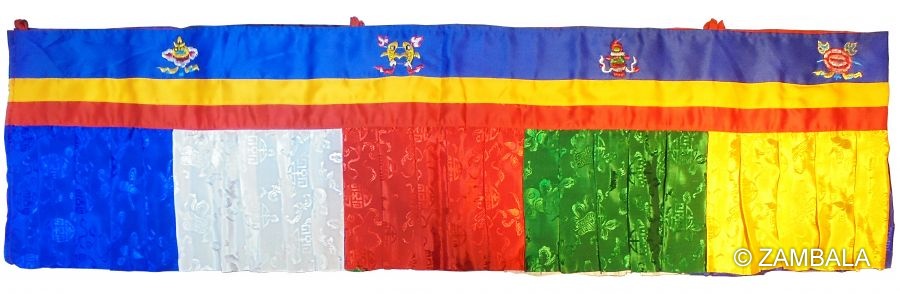
Material: Fabric, Embroidery, Printed, Boundary Cloth
Size: Approx. 500 cm long x 34.5 cm wide
Description:
**In Tibetan Buddhism, "boundary cloth" refers to **five-colored strips of cloth** (usually blue, yellow, red, white, and black) used to surround a temple or mandala during Tantric practices or temple arrangements. Its main purpose is to establish a "boundary" (sīmā-bandha), demarcating a sacred and protected space.
Origin and Development
- The concept of a boundary originated from the **early Buddhist Vinaya Pitaka**, used to demarcate boundaries during the Uposatha (recitation of precepts) of the Sangha to avoid violating certain precepts (such as separation from the assembly, staying overnight, etc.). This is the "established boundary" or "boundary already established."
- Later, during the **Vajrayana period** (especially the Shingon school and later Indian Tantras), the practice of establishing boundaries evolved into an important means of preventing interference from demonic obstacles, heretics, and non-human entities during rituals. It often involved inserting **Vajrakilaya (peppa)** at the four corners of the altar, and then using ropes or strips of cloth to create the boundary.
- After its introduction to Tibet, Tibetan Buddhism (especially the Nyingma, Sakya, Kagyu, and Gelug schools) further developed this practice, creating the custom of surrounding the entire temple or homa altar with **five-colored cloth**, hence the name "boundary cloth."
- The five colors symbolize the **Five Dhyani Buddhas, Five Wisdoms, Five Elements** or the **Five Deities**, and are highly related to the Vajrayana mandala system. This form can be traced back to the 8th century when Padmasambhava entered Tibet to propagate Buddhism; early monasteries such as Samye Monastery already used similar arrangements.
In short:
Ancient times → Ropes marked boundaries to signify ownership → Buddhist Vinaya (monastic rules) for demarcation → Tantric Buddhism for protection against demonic obstacles → Tibetan Buddhism → Five-colored cloth encircling the temple
Usage:
The most common Tibetan practice is as follows (actual practices may vary slightly depending on the school and lineage):
1. **Preparation**: Use strips of five-colored cloth (or wide cloth woven from five-colored silk threads), long enough to encircle the entire temple, mandala, or homa area.
2. **Blessing**: A qualified guru or lama recites relevant mantras (such as the Vajrakilaya mantra, boundary mantra, four-armed Avalokiteshvara mantra, Mahakala mantra, etc.), sometimes accompanied by visualization of the Five Dhyani Buddhas or the deity emitting light for blessing.
3. **Arrangement**:
- First, insert **Vajrakilaya** (phurbas) at the four corners or four sides of the temple and secure them.
- Wrap the five-colored cloth around the phurbas in a clockwise direction around the entire space (or the outer perimeter of the mandala).
- The cloth strip is usually hung high on the wall or stretched horizontally in a circle.
4. **Completion**: The master chants mantras, blows on it, or sprinkles it to purify the space, declaring the establishment of the boundary. Afterward, the space is considered a "sacred domain," and unauthorized personnel (especially non-believers or those who are not pure) should not enter casually to avoid disrupting the power of the boundary.
5. **Conclusion**: After the ceremony, the boundary is usually "removed" using a specific ritual, and the cloth is taken down and burned or disposed of properly.
In some cases, **five-colored threads** are used instead of the cloth strip, serving a similar function but focusing more on personal protection.
Impact on Buddhism (especially Tibetan Buddhism)
- **Enhancing the safety of tantric practices**: Tibetan Buddhism highly values the supreme tantric practice of "attaining Buddhahood in this very life," and the practice is prone to attracting demonic obstacles and external spiritual interference. The boundary cloth provides a powerful "energy firewall," allowing practitioners to focus more on advanced practices such as deity yoga, energy channels, and subtle points.
- **Symbolizing the Establishment of Sacred Space:** It transforms ordinary space into a sacred mandala, reminding practitioners that "this is no ordinary place," thus enhancing mindfulness and reverence.
- **Ritual Aesthetics and Cultural Heritage:** The combination of five-colored cloth and the vajra dagger has become a highly recognizable visual element in Tibetan monasteries, reinforcing the unique ritual atmosphere of Tibetan Buddhism and indirectly distinguishing it from Han and Theravada Buddhism in terms of visual culture.
- **Folk Belief Level:** Although originally a tool for advanced esoteric practices, it later influenced the Tibetan people, giving rise to many personal protective barriers (such as five-colored threads and sungkü protective knots), becoming one of the important mediums for Tibetan Buddhism to penetrate into the lives of ordinary people.
In summary:** **The protective cloth is a concrete tool for Tibetan Tantric Buddhism to "sanctify space," protecting practitioners and transforming the entire temple into a living mandala, making it easier for practitioners to enter the state of "Tathagatagarbha" or "deity resonance."
If you've ever seen those beautiful five-colored strips of cloth lining the main hall of a Tibetan monastery, that's it!
PS: If you need to replace old items that are dirty or damaged, and you can't burn them for a fire offering, please wrap them in a separate garbage bag and dispose of them properly. Never put them in the same garbage.

|
|
|
 |
|
|
|
|
|
|
|
|
|
|
|
|
|
|
|
|
© 2026 Zambala inc. All Rights Reserved. No part of this site may be reproduced without our written Permission.
Service Mail: ZambalaLLC@gmail.com
Phone: (626) 289-9787 or 1(888)Zambala (926-2252)
Fax: (626) 289-9719
1904 West Valley Blvd. Alahambra, CA 91803 USA
Unless stated otherwise in content's license. Design By
|
|
|