|
|
|
Wholesalers: |

|
/ |
|
|
|
|
|
|
|
|
| "All that we are is the result of what we have thought. If a man speaks or acts with an evil thought, pain follows him. If a man speaks or acts with a pure thought, happiness follows him, like a shadow that never leaves him." Shakyamuni Buddha (563-483 B.C.) |
|
|
|
|
|
|
|
|
|
|
|
|
|
|
|
|
|
|
|
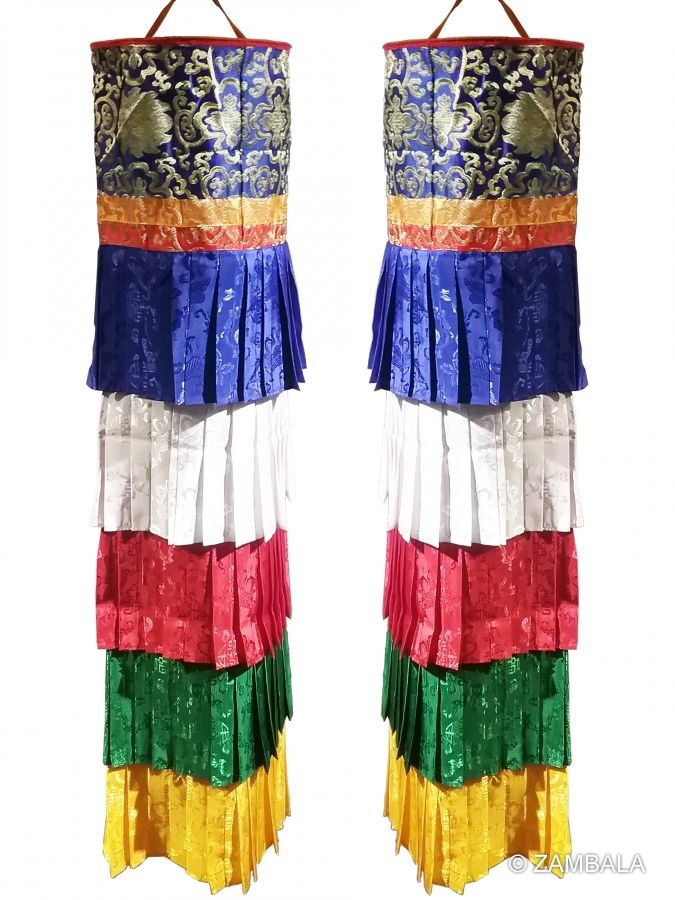
| Victory Banner (Gyaltsen) 4 ft (a set) |
|
|
|
|
|
Sku#:0585
|
|
|
Wholesale price |
US |
XXX.XX |
|
《In order to view the wholesale price .
Please Apply to be a wholesalers》
|
|
|
|
|
 |
|
Please contact us to verify availability. 1-626-354-6228
Email: zambalallc@gmail.com
America area customers can view on this website first.
https://FlyingMystics.org/ |
|
|
|
|
|
|
Material: Fabric, Tailoring, Embroidery, Printing (One Pair)
Size: Approximately 4 feet (120 cm) long
Description:
**The Meaning and Symbolism of the Victory Banner in Tibetan Buddhism**
In Tibetan Buddhism, the "Dharma Banner" usually refers to the "Victory Banner" (Sanskrit: Dhvaja, Tibetan: rgyal mtshan), also known as the Jewel Banner, Heavenly Banner, or Victory Banner. It is one of the Eight Auspicious Symbols of Buddhism, an important symbol commonly found on temple roofs, thangka paintings, ritual implements, and prayer flags.
Origin and Story
- **Origin**: The Victory Banner was originally a military standard used in ancient Indian warfare to symbolize victory and authority. Ancient Indian warriors would erect banners on their chariots to symbolize victory over the enemy.
- **Buddhist Transformation**: Buddhism adopted this symbol, transforming it into a symbol of the Buddha's enlightenment. Legend has it that when Shakyamuni Buddha attained enlightenment under the Bodhi tree, he overcame the temptations and obstacles of Mara (one of the four demons: Mara of afflictions, Mara of the senses, Mara of death, and Mara of the gods). This is considered a "victory" of knowledge over ignorance and the Dharma over evil. Therefore, the victory banner became a symbol of the Buddha's enlightenment, proclaiming that the Dharma triumphs over all obstacles.
- In Tibetan Buddhism, this symbolism has further developed, often manifesting as a copper cylindrical banner placed at the four corners of a monastery roof (such as the Potala Palace in Lhasa or other major temples), radiating in all directions, representing the spread of the Dharma in all directions.
Influence and Significance on Buddhism
- **Symbolic Meaning**:
- Represents the Buddha's victory over the four Maras, overcoming afflictions such as greed, anger, and ignorance, and achieving ultimate liberation.
- In Tibetan tradition, eleven forms of the victory banner are specifically listed, corresponding to eleven methods for overcoming afflictions (such as morality, concentration, wisdom, liberation, and great compassion). - Belonging to the category of exhortatory ritual implements, it is often inscribed with the six-syllable mantra or placed beside prayer wheels or mani stones to remind sentient beings to diligently practice and subdue inner demons.
- **Applications in Tibetan Buddhism**:
- Commonly found in monastery architecture (such as roof decorations), thangkas, and the Eight Auspicious Symbols, alongside the Dharma wheel, golden fish, and treasure vase.
- Symbolizes the eternal and indestructible nature of the Dharma, protecting the true Dharma and bringing auspiciousness and victory.
- Used in rituals and offerings to adorn the sacred space, praying for sentient beings to be free from suffering and attain Buddhahood.
Although the Victory Banner lacks an independent mythological story (such as a specific figure's legend), its symbolism is deeply integrated into the art, architecture, and practice system of Tibetan Buddhism, reminding practitioners that the Dharma is invincible and victory belongs to the right path.
.jpg)
|
|
|
 |
|
|
|
|
|
|
|
|
|
|
|
|
|
|
|
|
© 2026 Zambala inc. All Rights Reserved. No part of this site may be reproduced without our written Permission.
Service Mail: ZambalaLLC@gmail.com
Phone: (626) 289-9787 or 1(888)Zambala (926-2252)
Fax: (626) 289-9719
1904 West Valley Blvd. Alahambra, CA 91803 USA
Unless stated otherwise in content's license. Design By
|
|
|