|
|
|
Wholesalers: |

|
/ |
|
|
|
|
|
|
|
|
| "Our prime purpose in this life is to help others. And if you can't help them, at least don't hurt them."
~Dalai Lama XIV |
|
|
|
|
|
|
|
|
|
|
|
|
|
|
|
|
|
|
|
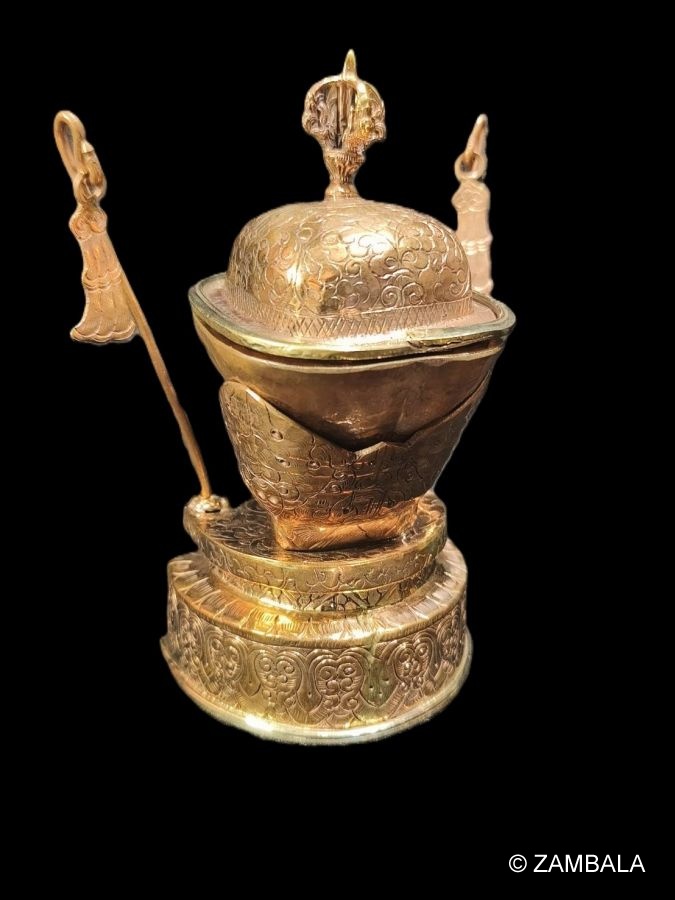
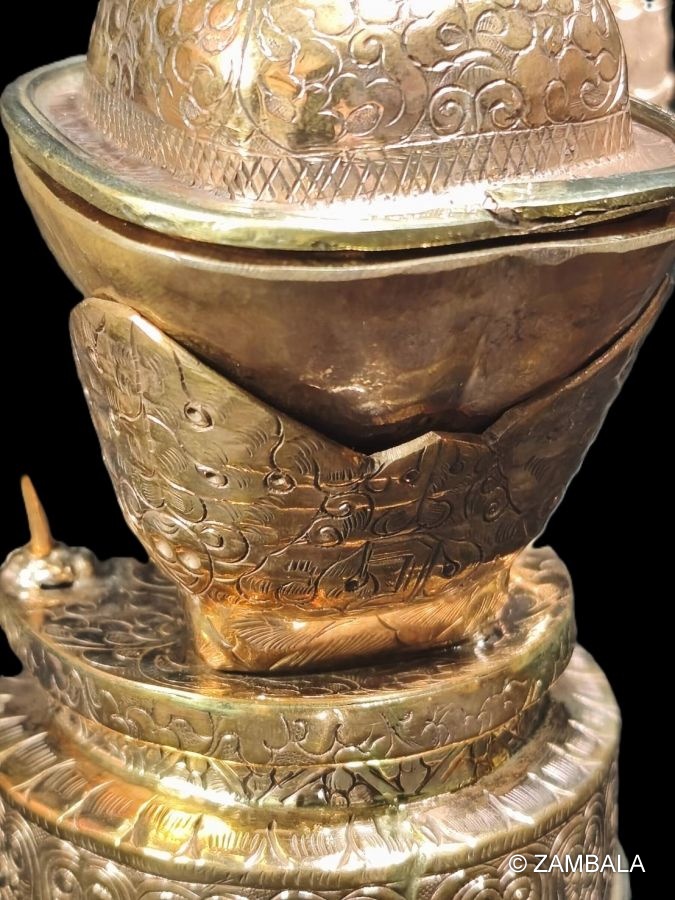
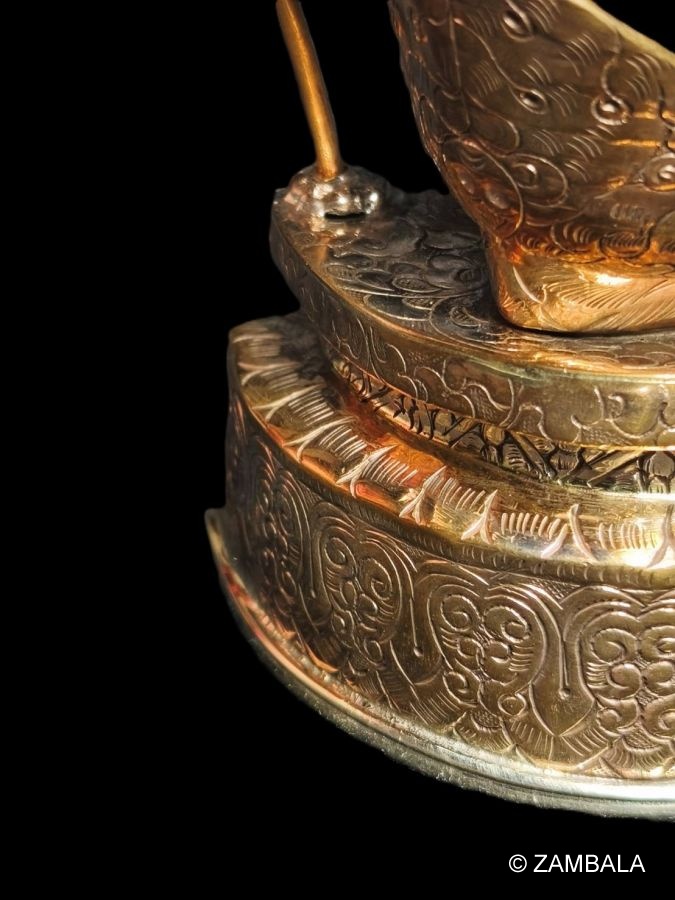
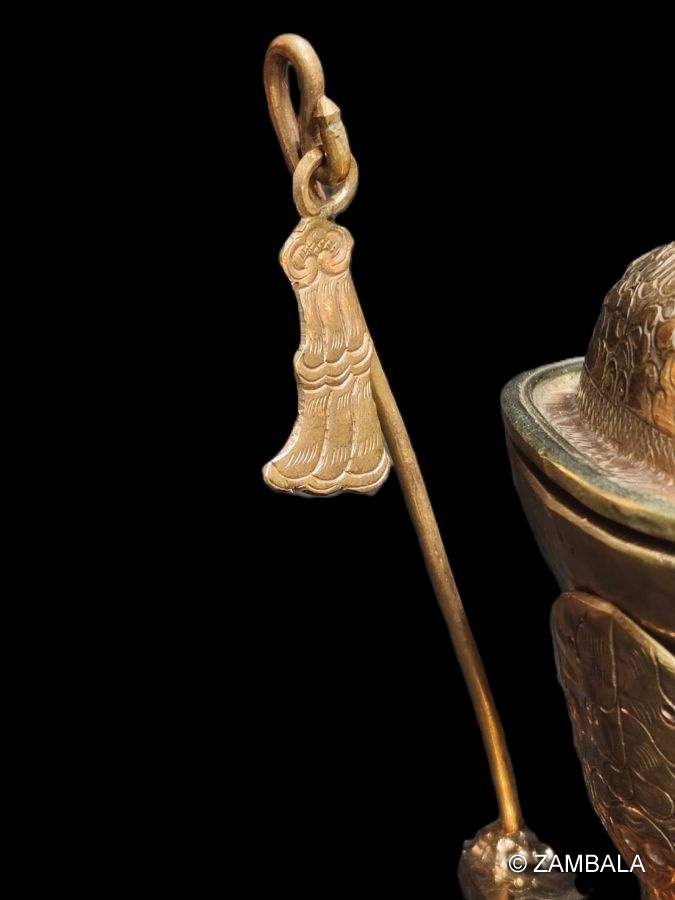
| Copper Kapala menra w/flag |
|
|
|
|
|
Sku#:3509
|
|
《In order to view the wholesale price .
Please Apply to be a wholesalers》
|
|
|
|
|
 |
|
Please contact us to verify availability. 1-626-354-6228
Email: zambalallc@gmail.com
America area customers can view on this website first.
https://FlyingMystics.org/ |
|
|
|
|
|
|
Material: Copper. Molded. Cast.
Size: 24cmH
Description: Kapala (Kapala bowl / Phra, Kapala bowl, Tibetan: ཀ་པ་ལ / kapāla, Sanskrit: kapāla)
"Kapala" is one of the most representative and easily misunderstood ritual implements in Tibetan Buddhism (Vajrayana/Tantric Buddhism). It refers to a bowl made from a human skull (skull bowl), usually used to hold offerings of wine, blood, internal organs, or nectar, and used in initiation, fire offerings, homa, and rituals involving fierce deities (such as Yamantaka, Hevajra, Chakrasamvara, etc.).
1. Origin and Legendary Sources
The origin of the kapala bowl has two main sources:
(1) Historical Practices of Indian Tantric Buddhism (8th-12th centuries)** The earliest skull bowls did indeed come from the Hindu and Tantric Buddhist tradition of "charnel house meditation". Yogis of that time (especially those accomplished practitioners around Nalanda and Vikramashila) would practice in charnel grounds (cemeteries). To break free from ego and purify their fear of "impurity," they would directly use unclaimed skulls to make tableware and ornaments. This is recorded in tantras such as the *Kalachakra Tantra*, *Hevajra Tantra*, and *Mahamaya Tantra*.
The most famous legendary figures include:
**2nd Patriarch: Nagarjuna (c. 2nd-3rd century)** → Legend says he offered his disciples nectar from a skull bowl.
**6th Patriarch: Saraha** → A Mahamudra master, often drank wine from a skull bowl, symbolizing "detachment from extremes."
**8th Patriarch: Tilopa** → He once ate fish entrails and drank wine from a skull bowl in a charnel ground, transmitting teachings to Naropa.
- **Ninth Patriarch: Naropa** → During Tilopa's rigorous trials, he was repeatedly required to eat and drink from a skull bowl.
- **Among the 84 Great Accomplished Ones**, more than 20 (such as Vivapa and his uncle and aunt) are described in their biographies as drinking wine and holding blood in skull bowls.
**(2) The Localized Legend of the Kapala in Tibetan Buddhism**
A more narrative origin story circulates among the Tibetan people: Long ago, there was an ascetic (or perhaps a hermit) named Kapala who practiced extremely rigorous head-mounted meditation, resulting in an exceptionally hard and smooth skull. Later, he was subdued by a Tantric deity (usually Chakrasamvara or Mahakala), and his skull was removed and made into a ritual implement, thus becoming the most exquisite Kapala bowl. This story is actually a folk tale adapted by Tibetan practitioners from the Indian charnel ground tradition, used to explain why some skull bowls are particularly spiritually significant (with natural patterns on the inner wall, a particularly clear sound when struck, etc.). The true source of a superior kapala bowl, according to Tibetan tantras, must be:
- The skull of a violently deceased person (killed in battle, accidentally fell to their death, killed by tigers or leopards, etc., the "seven kinds of raw kapala")
- Or the skull of an accomplished being after death (the "eight kinds of ripe kapala," the highest grade)
3. The significant influence of kapala on Buddhism (especially Tibetan Buddhism)
**(1) The core teaching symbolizing "transformation" and "non-duality"**
The core esoteric meaning of the kapala bowl is:
The most defiled things (skulls, impure objects) → through visualization and blessing → are transformed into the purest nectar
This is precisely the core idea of Vajrayana: "becoming a saint in the mundane," "afflictions are enlightenment," and "samadhi is nirvana." Using a kapala bowl to hold wine, blood, and the five kinds of meat and five kinds of nectar is a practice of "transforming impurity into purity and birth and death into Nirvana."
**(2) An indispensable ritual implement in initiation ceremonies** Almost all initiations in the Highest Yoga Tantra (Kalachakra, Hevajra, Yamantaka, Red and Black Mahakala, etc.), and the fourth initiation (the secret, wisdom, and union initiations following the vase initiation), require the use of a kapala bowl to hold nectar wine, which the disciple drinks, symbolizing "severing the discriminating thoughts of ordinary people and attaining non-dual wisdom."
**(3) A core implement for fire offerings and homa** Tibetan Buddhism's red and black fire offerings (pacifying, increasing, magnetizing, and subjugating), and inner and outer secret fire offerings all use kapala bowls to hold offerings, especially the subjugating fire offering which holds blood and meat, symbolizing the destruction of demonic obstacles.
**(4) The best means to break through common perception and self-grasping** For ordinary people, the skull bowl is the most terrifying "contemplation of impurity"; for practitioners of Tantra, however, it is the most precious ritual implement. This training of "inverted thinking" is precisely the unique method of Vajrayana for quickly overcoming the eighty-four thousand afflictions.
In summary, the kapala bowl, originating from the authentic tradition of charnel ground meditation in India, has evolved into the most symbolic ritual implement in Tibetan Buddhism. It is both a terrifying skull and a vessel of the purest nectar; both a symbol of death and proof of the realization of non-birth. Therefore, Padmasambhava said:
"Outwardly appearing terrifying, inwardly containing the treasury of nectar, the kapala bowl is filled with great bliss and wisdom."
This is the most profound meaning of the kapala in Tibetan Buddhism.
|
|
|
 |
|
|
|
|
|
|
|
|
|
|
|
|
|
|
|
|
© 2026 Zambala inc. All Rights Reserved. No part of this site may be reproduced without our written Permission.
Service Mail: ZambalaLLC@gmail.com
Phone: (626) 289-9787 or 1(888)Zambala (926-2252)
Fax: (626) 289-9719
1904 West Valley Blvd. Alahambra, CA 91803 USA
Unless stated otherwise in content's license. Design By
|
|
|