|
|
|
Wholesalers: |

|
/ |
|
|
|
|
|
|
|
|
| "No one lights a lamp and puts it in a place where it will be hidden, or under a bowl. Instead he puts it on its stand, so that those who come in may see the light." Jesus Christ |
|
|
|
|
|
|
|
|
|
|
|
|
|
|
|
|
|
|
|
|
|
|
|
|
Sku#:2599-1
|
|
|
Wholesale price |
US |
XXXX.XX |
|
《In order to view the wholesale price .
Please Apply to be a wholesalers》
|
|
|
|
|
 |
|
Please contact us to verify availability. 1-626-354-6228
Email: zambalallc@gmail.com
America area customers can view on this website first.
https://FlyingMystics.org/ |
|
|
|
|
|
|
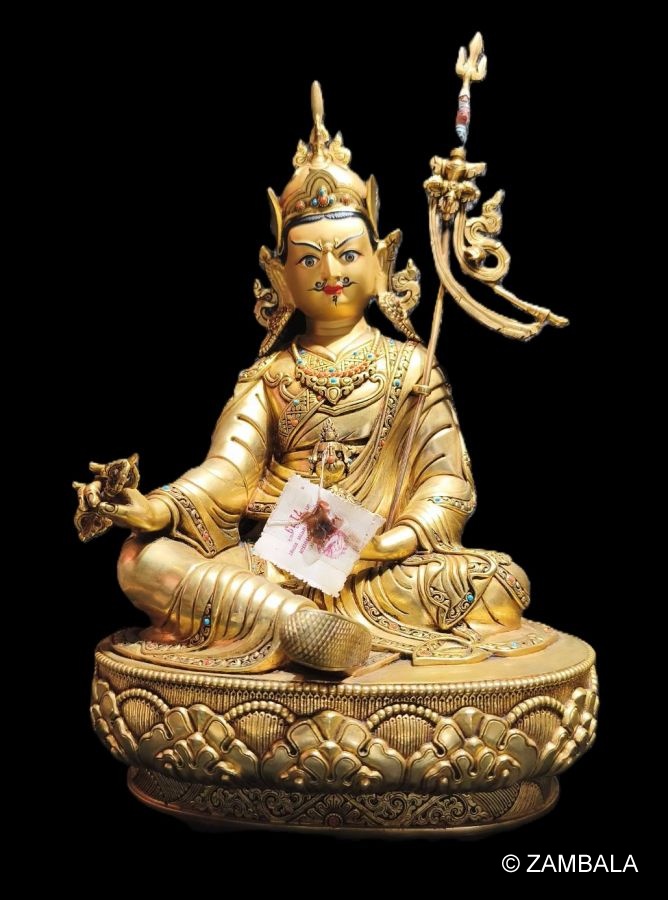
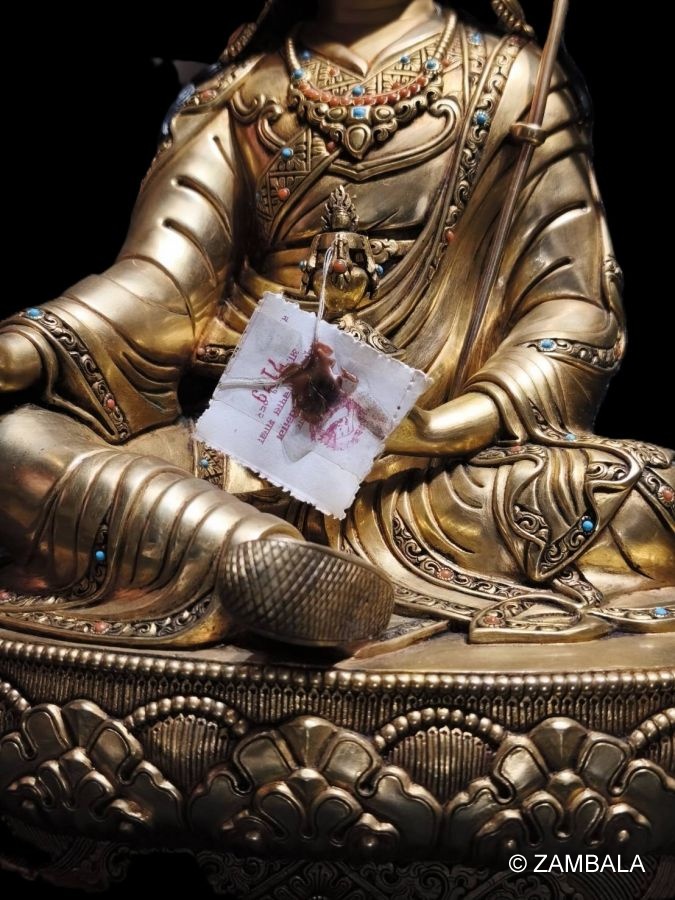
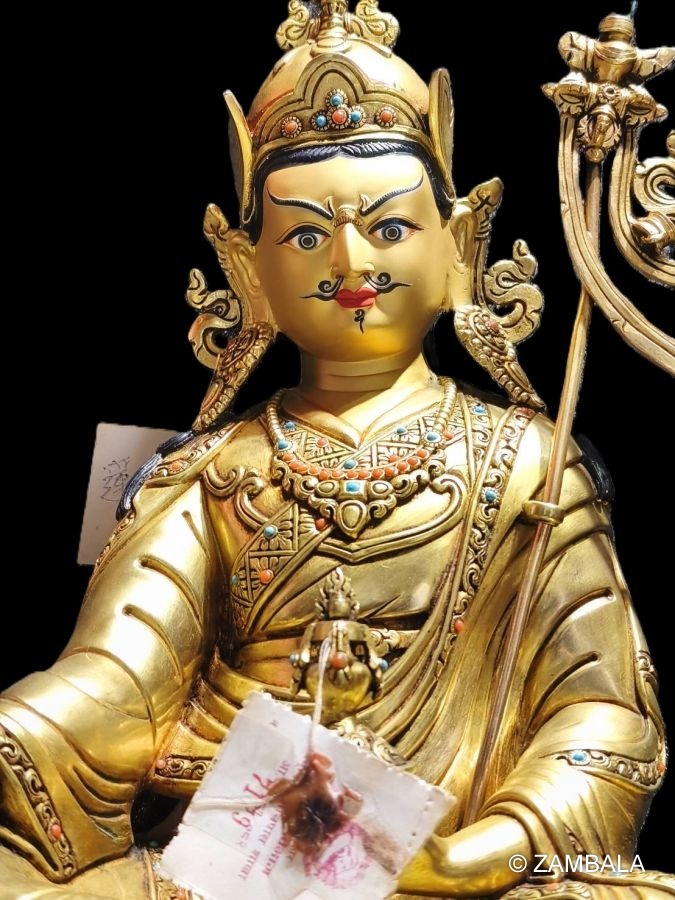
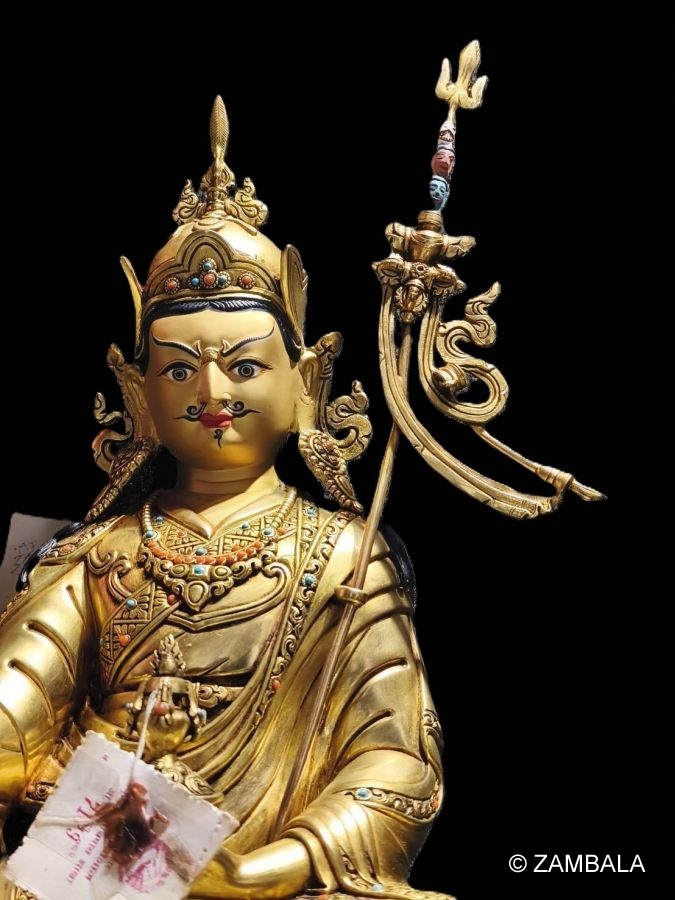
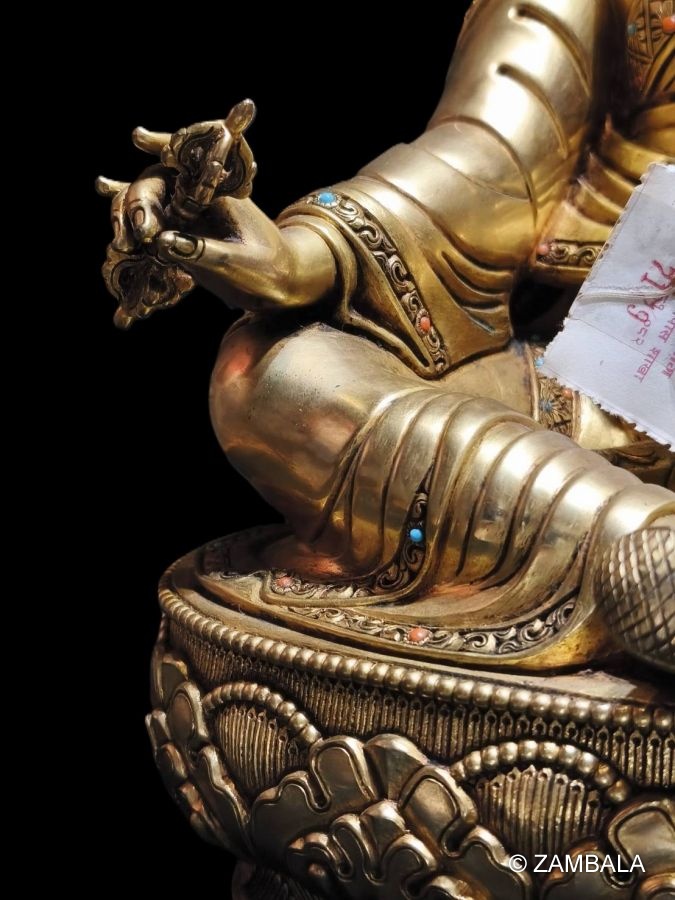
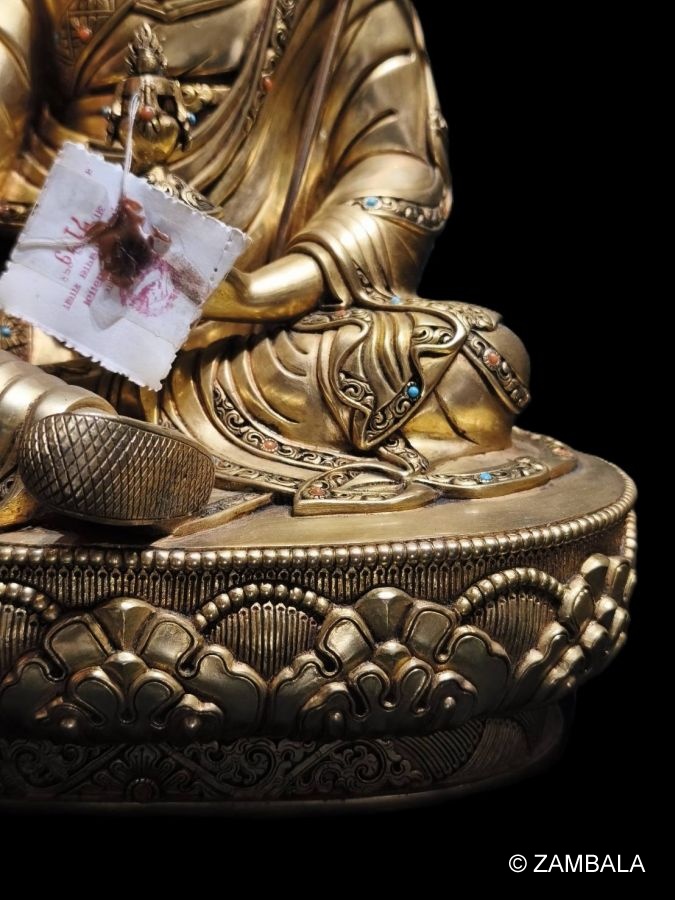
Material: Handmade in Nepal. Solid copper. Inlaid with gemstones. Gilded finish.
Size: 39 cm.
Description:
Padmasambhava (Sanskrit: Padmasambhava, Tibetan: པདྨ་འབྱུང་གནས་, meaning "born of the lotus"), is most revered by Tibetan Buddhists as Guru Rinpoche (precious master) or simply Padmasambhava. He is considered the "Second Buddha" and holds an extremely high position in Tibetan Buddhism (especially the Nyingma school), almost equivalent to an incarnation of Shakyamuni Buddha in this era.
Origin and Birth Legend: According to Tibetan Buddhist tradition, Padmasambhava was born around the 8th century in Oddiyana (present-day Swat Valley, Pakistan). The most famous birth story is:
He was not born from his parents' womb, but rather **emerged from the heart of a blooming lotus flower**.
Legend has it that King Indrabhuti of Uddiyana discovered an eight-petaled lotus flower in a lake, in the center of which sat an eight-year-old boy, dignified and exceptionally wise, holding a vajra and a skull cup. The king was awestruck, adopted him as his prince, and named him "Padmasambhava".
This "lotus birth" symbolizes his extraordinary birth, directly from the pure lotus (representing wisdom and purity), possessing the sublime embodiment of **the body of Amitabha Buddha, the speech of Avalokiteshvara Bodhisattva, and the mind of Shakyamuni Buddha**.
Main Life Stories
Padmasambhava's life was filled with miraculous transformations and legends, mainly divided into several stages:
1. **Seeking Dharma and Attaining Enlightenment in India**
He extensively studied the teachings of both exoteric and esoteric Buddhism, relying on numerous masters (such as emanations of deities like Manjushri and Vajrasattva), practicing in the eight great charnel grounds (charnel grounds), attaining great accomplishment (Mahasiddhi), able to subdue demonic forces and command spirits, and receiving titles such as "Wrathful Vajra."
He also married two principal dakinis: **Mandalava** (an Indian princess) and **Yeshe Tsogyal** (a Tibetan queen), both of whom attained the rainbow body.
2. **Propagation of Buddhism in Tibet (c. 747–804 AD)**
The Tibetan king **Trisong Detsen** wished to propagate Buddhism, but faced strong obstruction from local Bon forces and mountain gods and local spirits. The Indian master Shantarakṣita suggested invoking Padmasambhava.
After entering Tibet, Guru Rinpoche displayed immeasurable supernatural powers:
- Subdued local deities and demons (including the famous Twelve Earth Mothers of Tibet), causing them to vow to protect the Dharma.
- Generated springs with his staff, subdued poisonous dragons, and quelled natural disasters.
- Together with Trisong Detsen and Shantarakshita, he established Samye Monastery—the first monastery in Tibet to fully embody the Three Jewels of Buddha, Dharma, and Sangha (integrating Indian, Chinese, and Tibetan architectural styles).
- Founded the Sangha, ordaining the first seven Tibetan monks (the Seven Enlightened Ones).
- Invited masters such as Vimalamitra to organize the translation of numerous exoteric and esoteric scriptures.
3. **Leaving Tibet and Aftermath**
After propagating the Dharma in Tibet for several decades (some say 56 years), Guru Rinpoche foresaw a future crisis of Dharma extinction and sealed many profound teachings as **terma**, prophesying that future treasure revealers would retrieve them at the appropriate time. Afterwards, he went to the pure land of **Zangdok Palri (the land of Rakshasa)**, where he resided at the Lotus Light Palace and continues to benefit sentient beings in rainbow body form to this day.
Contributions to Buddhism (especially Tibetan Buddhism) Padmasambhava is widely recognized as the **founder of Tibetan Buddhism** and the **true initiator of Vajrayana (Tantric Buddhism) in Tibet**. His major contributions include:
- Transmitting the complete late Indian Vajrayana (Tantric Buddhism) to Tibet, making Tantra the core of Tibetan Buddhism.
- Establishing the fundamental lineage of the **Nyingma school** (ancient school), especially the main source of the Dzogchen lineage.
- Establishing the **treasure (treasure) tradition**: burying countless profound teachings (scriptures, deity practices, rituals, prophecies, etc.), which were subsequently unearthed by later tertons (such as Longchenpa and Chokyi Lingpa), and continue to appear to this day, adapting to the needs of sentient beings in different eras. The most famous terma (hidden treasures) include the *Tibetan Book of the Dead* (Bardo Thodol).
- Reconciling the contradictions between Buddhism and Bon: He absorbed some Bon rituals into Buddhism, successfully localizing Buddhism and allowing it to take root in Tibet.
- Leaving behind countless blessings and prophecies: Such as the famous **Seven-Line Vajra Prayer** (the Seven-Line Guru Rinpoche Prayer) and **Guru Rinpoche Mantra** (Om Ah Hum Vajra Guru Padma Siddhi Hum), which have become the most widespread and powerful practices in Tibetan Buddhism.
- The tenth day of each Tibetan month is the Guru Rinpoche Tsog Offering Day, and Tibetan Buddhists worldwide still commemorate him with grand ceremonies.
In short: Without Guru Rinpoche, there would be no **Tibetan Buddhism** as we know it today. He not only brought the Dharma to Tibet but also, with his supernatural powers, compassion, wisdom, and skillful means, permanently changed the spiritual landscape of the Tibetan Plateau. To this day, he is still regarded as a living Buddha and guru who never leaves sentient beings.
Those who are destined to do so can recite "Om Ah Hum Vajra Guru Padma Siddhi Hum" daily, and it is said that they can receive Guru Rinpoche's unique blessings, eliminate obstacles, increase wisdom, and be guided to the afterlife.
|
|
|
 |
|
|
|
|
|
|
|
|
|
|
|
|
|
|
|
|
© 2026 Zambala inc. All Rights Reserved. No part of this site may be reproduced without our written Permission.
Service Mail: ZambalaLLC@gmail.com
Phone: (626) 289-9787 or 1(888)Zambala (926-2252)
Fax: (626) 289-9719
1904 West Valley Blvd. Alahambra, CA 91803 USA
Unless stated otherwise in content's license. Design By
|
|
|