|
|
|
Wholesalers: |

|
/ |
|
|
|
|
|
|
|
|
| "Wisdom, compassion, and courage are the three universally recognized moral qualities of men." Confucius (Chinas most famous teacher, philosopher, and political theorist, 551-479 BC) |
|
|
|
|
|
|
|
|
|
|
|
|
|
|
|
|
|
|
|
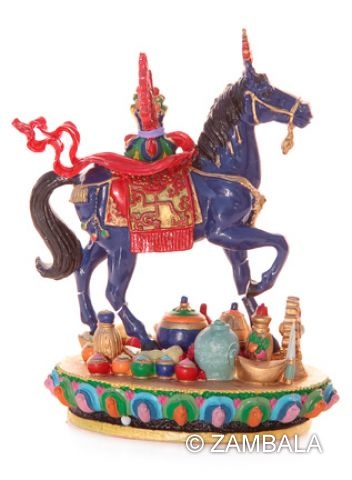
| Precious Horse hand painted (on sale) |
|
|
|
| Precious Horse hand painted |
|
Sku#:0075
|
|
《In order to view the wholesale price .
Please Apply to be a wholesalers》
|
|
|
|
|
 |
|
Please contact us to verify availability. 1-626-354-6228
Email: zambalallc@gmail.com
America area customers can view on this website first.
https://FlyingMystics.org/ |
|
|
|
|
|
|
Materials: Resin, Painted, Stand (Seven Treasures of the Horse)
Size: Approximately 12 x 15 cm
Description:
An Overview of the Horse in Buddhism
The Horse (also known as the Blue Horse, the Steed, or the Victory Horse) is one of the "Seven Treasures" (also known as the Seven Treasures of the Wheel King or the Seven Treasures of the Seven Treasures) possessed by the Chakravartin in Buddhism. These seven treasures include the Wheel, the Elephant, the Horse, the Mani Treasure (or Divine Jewel), the Jade Maiden, the Tibetan Minister (or Layperson's Treasure), and the General (or Military Minister's Treasure). The Chakravartin is the ideal worldly monarch in Buddhist scriptures, ruling the world with righteous Dharma and commanding obedience without the need for force. The Seven Treasures symbolize his authority, merit, and peace and prosperity. The horse is specifically described as a divine horse, a deep blue like a peacock's neck, free from all ill health, and its neighing can be heard throughout Jambudvīpa (the continent inhabited by humans). It possesses thirty-two characteristics of a divine horse (such as distinctive markings on its eyes, ears, and tongue), is draped in gold and jewels, and often carries divine jewels on its saddle. It possesses immense power, capable of swiftness like the wind, circling Jambudvīpa three times a day. Similar to Balahama King, an incarnation of Avalokitesvara, it can swiftly transport the king and his army at the will of the Chakravartin, bringing auspiciousness and blessings.
Role in Buddhist Ritual
In Buddhist rituals, the horse plays a primarily symbolic and devotional role. Rather than a physical horse, it appears as an image, model, or visualization of one of the seven treasures. In Tibetan Buddhism, in particular, the seven treasures are often used in monastery halls, through decoration, painting, carving, and offerings, symbolizing the auspiciousness and world peace associated with the birth of a chakravartin. The horse treasure specifically represents the quality of "diligence," courageously forging ahead and swiftly reaching the other shore. It encourages practitioners to diligently cultivate and quickly escape samsara.
- **Offering Function**: Devotees often place models of the seven treasures in Buddhist temples or mandalas, visualizing them as real, rare treasures and offering them to the Three Jewels of Buddha, Dharma, and Sangha to accumulate immense merit. Although the actual seven treasures do not exist in this evil world of the Five Turbidities, offering them through mental visualization (i.e., contemplating them) can also yield extraordinary merit, bringing immeasurable wealth, successful careers, and the spread of the Dharma for the benefit of all beings. For example, during rituals such as offerings to auspicious objects, offerings to deities, and practicing Dharma, the horse treasure is considered one of the best offerings, helping practitioners to increase their enlightenment and overcome obstacles.
- **Symbodic Meaning**: The horse treasure corresponds to the "energy factor" of the Seven Factors of Enlightenment (Seven Bodhi Factors) in Buddhism, emphasizing diligently upholding wholesome dharma, abandoning evil and embracing good, and abiding in non-discriminatory wisdom without effort. It symbolizes the mobility and speed of cavalry, helping practitioners quickly reach the desired other shore. In Mahayana Buddhist texts, this is likened to the "renunciation factor" of Bodhi, capable of subduing afflictions and increasing wisdom.
- **Human Heart Metaphor**: In some interpretations, the horse treasure also metaphorically represents the quality of "diligence" in the human heart, representing obedience, loyalty, and pliability, encouraging beings to advance courageously in their spiritual practice.
In Theravada or Chinese Buddhism, the ritual use of the horse treasure is less common, but it is often mentioned during scripture recitations or teachings as a symbol of the ideal rule of a chakravartin, reminding believers to pursue the dharma and inner peace.
Origin
The origin of the horse treasure originates from Buddhist scriptures, with the earliest mention in ancient Indian Buddhist texts, which describe the spontaneous manifestation of seven treasures upon the birth of a chakravartin, symbolizing his merit and dharma rule. Specific texts include:
- The Mahāratnakūṭa Sūtra: This text details the seven treasures of a chakravartin and their functions. The horse treasure is described as a divine horse, capable of swift movement at the king's will. - The Dīrghāgama and Madhyamāgama Sūtras mention the seven treasures of the Chakravartin's reign, with horses used as a means of transportation and conquest.
- The Avatamsaka Sūtra and the Ratnakūta Sūtra emphasize the auspicious symbolism of the seven treasures, with horses representing diligence and rapid achievement.
- The Sūtra on the Seven Treasures of the Chakravartin discusses the origin and function of the seven treasures.
These texts originate from the teachings of Shakyamuni Buddha. The concept of the Chakravartin is influenced by ancient Indian mythology (such as the chakravartin in Hinduism), but in Buddhism it is transformed into a metaphor for morality and reincarnation, emphasizing impermanence and contentment. The seven treasures are not tangible objects, but miracles inspired by merit, appearing only during the golden age of the Chakravartin.
Related Stories
The most famous horse-treasure story in Buddhist canon is related to the legend of the wheel-turning sage king, King Mandhātā (also translated as King Rānkā or King Dīngshān), found in the Zhongtai World Buddhist Stories and other texts. This is a classic parable warning against greed:
Long ago, there was a wheel-turning sage king named Dīngshān. He governed the southern continent of Jambudvīpa with righteous Dharma. His kingdom was free of evildoers, prosperous, and abounding with treasures. He possessed seven treasures: the Golden Wheel (for ruling the four continents), the White Elephant (for transportation by a divine elephant), the Blue Horse (for swift divine steeds), the Divine Pearl (for illuminating darkness), the Jade Maiden (for attendants and assistance), the Layperson (for managing the people), and the Lord of Arms (for commanding the army). These treasures materialized at the king's thought, enabling him to rule the four continents (including Jambudvīpa and the Southern Continent) without the use of force, and to have a thousand strong sons.
The horse treasure plays a key role in the story: it can travel a thousand miles a day, swiftly transporting King Dinara and his army throughout the four continents, disappearing and coming, aiding the king in his conquests and rule. Initially content, King Dinara enjoyed a long life, good health, a striking appearance, and a wealth of treasures. But gradually, greed seized him, and he first conquered the four continents and then sought to ascend to the Thirty-three Heavens (Trayastrimsa Heaven). The horse treasure and other treasures helped him ascend to the heavens, forcing Indra (Śakra) to relinquish half of his throne.
However, King Dinara, unsatisfied, harbored evil intentions, desiring to monopolize the throne and kill Indra. Instantly, the seven treasures lost their power: the horse treasure and the white elephant treasure perished, and the golden wheel treasure and others vanished. The king and his army fell from the sky to the southern Jambuvipa. King Dinara developed a sore on his head, bleeding from all seven orifices, and died in agony. His sons tried to treat him, but to no avail, and King Dinara repented of the harm of greed.
The Buddha told this story to Venerable Ananda, revealing that King Dhāraṇī was his previous life. The moral principle is: Greed is like the rain, bringing little joy and much suffering; the wise should reject it. Living beings, driven by a single thought of lust, pursue endlessly, just as King Dhāraṇī enjoyed all the splendors but remained greedy, ultimately leading to their downfall. The Buddha taught that eliminating greed is the only way to escape the suffering of samsara. The verse reads: "Lust is like the rain, insatiable in desire; bringing little joy and much suffering; the wise reject it."
This story emphasizes the impermanence of the seven treasures (including the horse), which exist only through merit. It reminds practitioners to be content and diligent, and not to covet worldly possessions.
|
|
|
 |
|
|
|
|
|
|
|
|
|
|
|
|
|
|
|
|
© 2026 Zambala inc. All Rights Reserved. No part of this site may be reproduced without our written Permission.
Service Mail: ZambalaLLC@gmail.com
Phone: (626) 289-9787 or 1(888)Zambala (926-2252)
Fax: (626) 289-9719
1904 West Valley Blvd. Alahambra, CA 91803 USA
Unless stated otherwise in content's license. Design By
|
|
|