|
|
|
Wholesalers: |

|
/ |
|
|
|
|
|
|
|
|
| "Peace is present right here and now, in ourselves and in everything we do and see. The question is whether or not we are in touch with it."
~Thich Nhat Hanh |
|
|
|
|
|
|
|
|
|
|
|
|
|
|
|
|
|
|
|
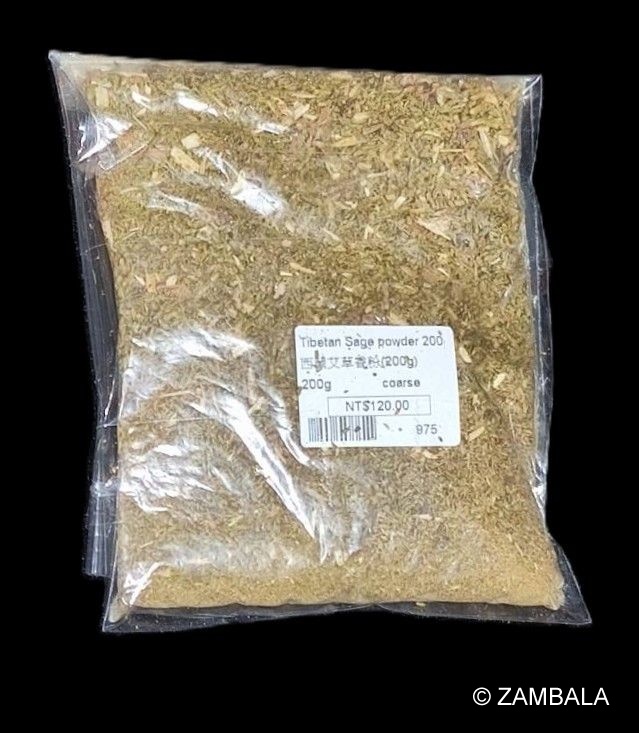
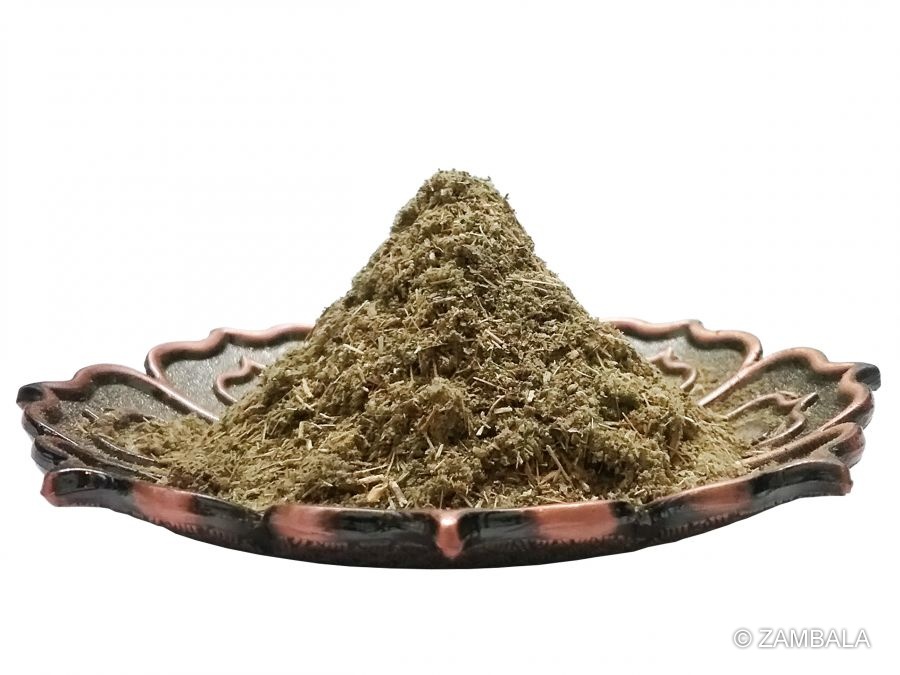
| Tibetan Sage inc. powder (200 gram) |
|
|
|
|
|
Sku#:0975
|
|
《In order to view the wholesale price .
Please Apply to be a wholesalers》
|
|
|
|
|
 |
|
Please contact us to verify availability. 1-626-354-6228
Email: zambalallc@gmail.com
America area customers can view on this website first.
https://FlyingMystics.org/ |
|
|
|
|
|
|
Material: Mugwort. Raw material (for fire offerings and smoke offerings)
Size: Bulk. 200g. Raw material. Coarse product
Description: Overview and uses of mugwort
Mugwort (scientific name: *Artemisia argyi*), also known as wormwood, is a perennial herbaceous plant belonging to the genus *Artemisia* of the Asteraceae family. It holds a very important place in traditional Chinese culture. Its leaves are densely covered with white downy hairs, and it has a strong, fragrant aroma. It has been widely used in traditional Chinese medicine, health preservation, folk customs, and religious ceremonies since ancient times.
Main uses
1. **Traditional Chinese Medicine Moxibustion**
The most famous use is in making "moxa wool" or "moxa sticks" for moxibustion therapy. The mugwort leaves are dried, crushed into a wooly powder, and made into moxa cones or sticks. These are then lit and applied to acupoints through the skin or directly to achieve the effects of warming and unblocking the meridians, dispelling cold and dampness, and regulating qi and blood. This method is recorded in the *Huangdi Neijing* (Yellow Emperor's Inner Classic) and is a classic technique in traditional Chinese medicine's external treatment methods.
2. **Dragon Boat Festival Customs**
Every year on the fifth day of the fifth lunar month, the Dragon Boat Festival, people bundle mugwort and hang it at their doors, or weave it into "mugwort tigers" to wear, believing it can ward off evil spirits, insects, and plagues. This custom originates from the ancient belief that May was a "poisonous month," and the strong scent of mugwort could repel foul air and mosquitoes.
3. **Incense and Bathing**
Boiling mugwort leaves in water for bathing (mugwort bath), or burning it to fumigate houses, can repel mosquitoes, dehumidify, and sterilize. Mugwort is also used to make sachets, pillows, etc.
4. **Food and Medicinal Uses**
In some regions (such as Jiangnan), glutinous rice wrapped in mugwort leaves is used to make traditional foods such as "mugwort cakes" and "green dumplings," which have both medicinal value and symbolize the arrival of spring.
Origin of Uses
The use of mugwort can be traced back to the pre-Qin period. The Book of Songs already contains the record "They gather mugwort," indicating that it was already being used for medicinal purposes at that time. From the Warring States period to the Han Dynasty, traditional Chinese medicine classics (such as *Fifty-Two Prescriptions* and *Huangdi Neijing*) formally recorded moxibustion therapy. The custom of hanging mugwort during the Dragon Boat Festival is related to commemorating Qu Yuan and the ancients' fear of "plague." The *Customs and Traditions* of the Eastern Han Dynasty already stated, "Decorating doors with mugwort to ward off plague." From the Tang and Song Dynasties onward, mugwort's status in folk medicine became more stable, becoming known as the "King of Herbs."
### The Influence of Mugwort on Buddhist Culture
Although mugwort originated in indigenous Chinese Taoism and folk beliefs, with the introduction of Buddhism to China (Eastern Han Dynasty) and its deep integration with local culture, it gradually incorporated into Buddhist rituals and practices, mainly in the following aspects:
1. **Incense and Purification Ritual**
Buddhist temples often use mugwort incense to purify the environment and repel mosquitoes, especially in humid southern regions. The strong aroma of mugwort is believed to "ward off evil and cleanse," consistent with the Buddhist concept of a "pure practice place." 1. Some temples burn mugwort sticks for incense in the Buddha hall or monks' quarters, similar to offering incense to Buddha.
2. **Temple Customs of the Dragon Boat Festival**
Many Han Chinese Buddhist temples retain the tradition of hanging mugwort and wearing sachets during the Dragon Boat Festival. Monks hang mugwort at the temple gate or distribute mugwort sachets to believers, both continuing folk customs and symbolizing the warding off of disasters and illnesses, and bringing good fortune and peace. This reflects the integration of Buddhism with folk festivals after its Sinicization.
3. **The Combination of Traditional Chinese Medicine and Buddhist Health Preservation Culture**
Buddhism emphasizes "protecting life" and physical and mental health, and many temples have medical rooms or pharmacy halls. Moxibustion, as a gentle traditional Chinese medicine therapy, is used by some monastic doctors to treat diseases caused by wind, cold, and dampness. When the famous Tang Dynasty monk-physician Jianzhen traveled to Japan, he also introduced traditional Chinese medicine techniques such as moxibustion, which had a profound influence on Japanese Kampo medicine.
4. **Extended Symbolic Meaning**
In Buddhist culture, mugwort is sometimes associated with "asceticism" and "purification"—its strong aroma is believed to dispel impurities, analogous to practitioners using asceticism to eliminate afflictions. Some Zen koans and folk Buddhist stories also occasionally mention mugwort as a purification tool.
In summary, mugwort, originally a native Chinese medicinal and folk plant, was absorbed into temple life and festival customs during the introduction and localization of Buddhism, becoming a microcosm of the "secularization" and "life-oriented" nature of Han Chinese Buddhism. It retains its traditional functions of exorcising evil and curing diseases while also being endowed with the Buddhist cultural connotations of purity and the protection of life.
|
|
|
 |
|
|
|
|
|
|
|
|
|
|
|
|
|
|
|
|
© 2026 Zambala inc. All Rights Reserved. No part of this site may be reproduced without our written Permission.
Service Mail: ZambalaLLC@gmail.com
Phone: (626) 289-9787 or 1(888)Zambala (926-2252)
Fax: (626) 289-9719
1904 West Valley Blvd. Alahambra, CA 91803 USA
Unless stated otherwise in content's license. Design By
|
|
|